
Seven AI Engines for 2026: Why Gemini and Google AI Mode Joined the Canonical Set
The canonical AI engine set expanded from five to seven in June 2026 with the addition of Gemini and Google AI Mode. Gemini retrieves heavily from Reddit, YouTube, and Quora — sources weighted less heavily by ChatGPT or Claude. Google AI Mode replaces traditional ranked search results with AI-synthesised answers entirely. Brands cited consistently across the original five engines may have gaps in these two. This article documents what changed, why these two engines met the canonical criteria, why others did not, and what changes operationally for Irish SMEs.
 By Lee Graham · Published · Updated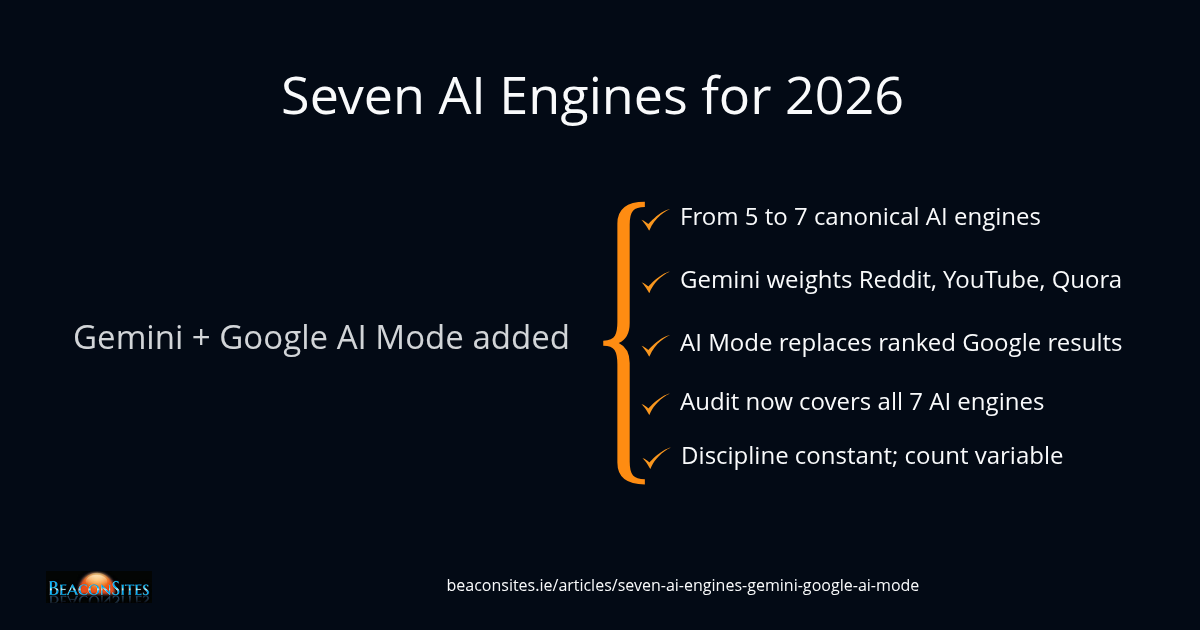
On 2026-06-29, BeaconSites' canonical AI engine set expanded from five to seven. The two additions are Gemini, Google's standalone conversational AI, and Google AI Mode, Google's AI-first search interface that replaces traditional ranked results entirely. Both met BeaconSites' four criteria for canonical status: sustained mainstream usage, distinct retrieval surface, demonstrated impact on commercial queries, and measurable citation behavior in independent third-party studies.
This article documents what changed, why these two engines were added, why other AI products were not, and what changes operationally for Irish SMEs operating against the original five-engine framework.
The original five engines — ChatGPT, Claude, Perplexity, Google AI Overviews, Microsoft Copilot — were documented in The Five AI Engines That Now Decide Whether Your Business Gets Found. That article remains the historical baseline for the canonical set as it existed through the first half of 2026. The two engines added in this update fit alongside the original five rather than replacing them; the framework now tracks seven.
For context on why multi-engine tracking matters, see What Is Consensus Signal. For evidence that most AI citations come from third-party sources rather than owned content, see Why AI Engines Cite Third-Party Sources Over Your Own Website.
Why the canonical engine set has criteria — and how Gemini and Google AI Mode met them
BeaconSites does not track every AI product that emerges. Tracking too broadly dilutes the AEO framework and forces operational attention onto engines that do not meaningfully drive commercial query results for Irish SMEs. Tracking too narrowly leaves blind spots that competitors exploit. Four criteria determine whether an AI engine joins the canonical set.
Sustained mainstream usage. The engine must show ongoing weekly or monthly active user growth across multiple consecutive measurement periods, not a single launch-window spike. Volatile or declining engines are not canonical.
Distinct retrieval surface. The engine must retrieve from a partially distinct content pool, weight signals differently, or cite different brands than other canonical engines for similar queries. Engines whose behavior is indistinguishable from an already-canonical engine are redundant.
Demonstrated impact on commercial queries. The engine must produce measurable citation outcomes for brand recommendation queries, vendor comparison queries, or local intent queries — the categories that drive Irish SME revenue. Engines that handle only general-knowledge queries are not commercially canonical.
Measurable in third-party citation studies. The engine must be tested in independent research with reproducible methodology, not just self-reported usage stats. MuckRack's May 2026 generative pulse study measured Gemini explicitly, providing the third-party verification needed for canonical inclusion.
Gemini met all four criteria through 2025 and the first half of 2026. Google AI Mode met all four by mid-2026, with the strongest evidence on the distinct retrieval surface criterion: it replaces traditional search results entirely, which produces a fundamentally different user journey than AI Overviews appearing above ranked results.
The canonical AI engine set expanded from five to seven in June 2026 with the addition of Gemini and Google AI Mode.
Gemini — Google's standalone conversational AI
Gemini is Google's standalone conversational AI, accessed at gemini.google.com or through the Gemini mobile app. It is operationally distinct from Google AI Overviews, which appears within standard Google search results, and from Google AI Mode, which replaces standard results. Gemini is powered by Google's Gemini model family.
The most significant Gemini-specific finding comes from MuckRack's May 2026 generative pulse study, which measured the source patterns of citations across ChatGPT, Claude, and Gemini. Gemini's top-cited domains for commercial queries were Reddit, YouTube, and Quora — three platforms that ChatGPT and Claude weight far less heavily. This is a material divergence in retrieval behavior.
The operational implication for Irish SMEs is direct: a brand that has built strong citation presence in editorial outlets, review platforms, and structured data on its own site may still be invisible to Gemini if it has no presence on Reddit, YouTube, or Quora. The signals Gemini weights most heavily live in places where brands rarely operate intentionally.
To improve Gemini visibility, brands should build a thin but consistent YouTube presence with proper metadata and structured content, monitor Reddit for branded mentions and engage genuinely where relevant, build a Quora answer presence around buyer-journey questions where the brand has demonstrable expertise, and ensure schema markup on the brand's own site explicitly identifies the brand entity.
Gemini visibility compounds slowly because the platforms it weights most heavily reward sustained presence over campaign-style bursts. Brands that begin building Gemini-targeted infrastructure now establish positions that late entrants take twelve to eighteen months to match.
Brands cited by ChatGPT or Claude may be invisible to Gemini if they lack presence on Reddit, YouTube, or Quora.
Google AI Mode — the AI-first replacement for traditional Google search
Google AI Mode is Google's AI-first search interface, launched in beta through 2025 and rolled into broader availability through early 2026. It is structurally different from Google AI Overviews. AI Overviews appears within standard Google search results pages, alongside traditional ranked listings. AI Mode replaces traditional results entirely with an AI-synthesised answer flow.
AI Mode is powered by Gemini models on the AI side and Google Search infrastructure on the retrieval side. This makes AI Mode the only canonical engine that combines Google's full search index with Gemini's reasoning capability. The retrieval behavior is more similar to Google AI Overviews than to standalone Gemini, but the user journey is fundamentally different.
The strategic significance of AI Mode is that it represents Google's stated direction for search: the AI-first interface eventually becomes the default, with traditional ranked results moved to a secondary view. Brands that have built their entire visibility strategy around capturing clicks from ranked positions are most exposed to this shift. There are no ranked positions to capture clicks from in AI Mode — there are only citations within the synthesised answer.
To improve Google AI Mode visibility, brands should maintain strong on-page SEO foundations (still the retrieval substrate), build structured data that exposes brand facts in machine-readable form, develop FAQ content and definition-first paragraphs that AI Mode can extract directly into synthesised answers, build YouTube presence with structured metadata, and monitor AI Mode behavior on branded and category queries to identify where competitors are being cited and the brand is not.
AI Mode citation patterns are still stabilising as Google iterates on the product. The brands that will benefit most from AI Mode visibility are those that build the optimisation foundations now, before Google's signal weighting fully settles.
Google AI Mode replaces traditional ranked search results entirely. There are no ranked positions to capture clicks from — only citations within the synthesised answer.
Why Grok, Bing AI, and other AI products are not in the canonical set
Several AI products are visible in the broader AI search ecosystem but do not meet BeaconSites' canonical criteria as of mid-2026.
Grok (xAI). Grok has substantial user volume on X and an integrated chat product. It is excluded from the canonical set for two reasons. First, its retrieval surface is heavily X-centric in ways that limit its commercial query citation patterns for Irish SMEs.
Second, MuckRack's May 2026 study and other independent generative pulse research did not measure Grok with reproducible methodology, leaving the third-party verification criterion unmet. If Grok's commercial query citation patterns become measurable in independent research and meaningful for Irish SME buyer behavior, BeaconSites will revisit canonical status.
Bing AI. What was originally branded as Bing AI Chat has been largely subsumed into the Microsoft Copilot brand and product surface. Tracking Bing AI as a separate canonical engine would double-count the Copilot retrieval surface. Microsoft Copilot remains canonical; Bing AI is not tracked separately.
Pi, Llama-based assistants, character-style AI products. Several AI products serve real user needs but operate outside the commercial query mainstream. Pi (Inflection) is a conversational companion. Llama-based open-source assistants are developer infrastructure.
Character-style products are entertainment. None meet the commercial query impact criterion for Irish SMEs.
You.com, Phind, and other niche AI search products. Focused use cases with real but limited audiences. None reach the sustained mainstream usage threshold or appear in commercial query citation studies. Worth monitoring for category expansion but not currently canonical.
The canonical set is not closed. As new AI products meet the four criteria — or as existing canonical engines lose their commercial relevance — the set will evolve. BeaconSites will document any future canonical changes with the same evolution-narrative approach used here.
The framework is unchanged. The engine count is the variable; the discipline is constant.
What changes operationally for Irish SMEs
The seven-engine landscape changes three operational things for Irish SMEs already operating against the original five-engine framework.
Audit surface expansion. The BeaconSites AI Visibility Audit now tests presence across all seven engines simultaneously. Brands that audited against the original five before mid-2026 should expect to find new gaps in Gemini (especially around Reddit, YouTube, and Quora presence) and Google AI Mode (especially around schema markup and YouTube structured metadata). These gaps are not failures of the original audit — they are surface expansion. The recommended action is a re-audit on the seven-engine surface within sixty days of the canonical update.
Distribution layer adjustments. The original five engines weighted distribution heavily for Perplexity. Gemini's heavy weighting of Reddit, YouTube, and Quora means distribution strategy now extends beyond traditional news syndication. The BeaconSites Content Creation and Syndication service has been updated to include YouTube structured-content distribution and authentic community presence development as part of the standard scope.
Schema and structured data prioritisation. Google AI Mode's reliance on schema markup raises the operational priority of structured data across all canonical AI engines. Brands that had treated schema markup as nice-to-have should reclassify it as critical infrastructure. Every BeaconSites build engineers schema markup that matches Google's structured data expectations and exposes brand facts in machine-readable form. This applies retroactively to existing sites through the AI Visibility Audit upgrade path.
For Irish SMEs not yet operating against any structured AI visibility framework, the seven-engine landscape does not change the starting point. The starting point remains a baseline AI Visibility Audit, followed by infrastructure investment in the gaps the audit identifies. The audit framework now simply produces a seven-engine surface map instead of a five-engine map.
Brands that began building infrastructure during the original five-engine window carry that infrastructure forward. The marginal additions for Gemini and Google AI Mode are smaller than starting from scratch.
The seven-engine landscape from here forward
The seven engines — ChatGPT, Claude, Perplexity, Gemini, Google AI Overviews, Google AI Mode, Microsoft Copilot — are the operational baseline for BeaconSites' AEO framework as of mid-2026. The framework itself is unchanged: production, transformation, distribution, plus the consensus signal layer that compounds across all surfaces. The engine count is the variable; the discipline is constant.
Future canonical changes will be documented as they happen, in dedicated follow-up articles like this one. The criteria remain the four documented above. Engines that meet all four criteria become canonical. Engines that no longer meet any of the four are removed.
The multi-engine moat strategy now compounds across seven retrieval surfaces rather than five. This is meaningful for brands that began building infrastructure during the original five-engine window: the existing infrastructure carries forward; the marginal additions for Gemini and Google AI Mode are smaller than starting from scratch. For brands that have not yet begun, the operational equation is unchanged.
The moat still compounds over two to three years. The brands that start now still establish positions that late entrants cannot easily contest. The starting line is just slightly further out than it was six months ago.
For Irish SMEs assessing where they currently stand, the AI Visibility Audit tests presence across all seven engines and identifies which gaps matter most for the specific buyer profile. For operating across all seven engines at meaningful intensity, the Content Creation and Syndication service is the operational answer. The framework for both has been updated to reflect the seven-engine baseline.
Data and evidence
| Data point | Value | Source |
|---|---|---|
| Top-cited domains for Gemini commercial queries (consistent across study) | Reddit, YouTube, Quora | MuckRack Generative Pulse Study, May 2026 (25M+ link analysis across ChatGPT, Claude, Gemini) |
| AI citations from third-party sources (not owned brand content) | 84% (across ChatGPT, Claude, Gemini) | MuckRack Generative Pulse Study, May 2026 |
| AI citation rate from journalism for industry-trend queries | 46% (2x rate of how-to queries) | MuckRack Generative Pulse Study, May 2026 |
| AI citations from journalism articles published in past 12 months | 57% | MuckRack Generative Pulse Study, May 2026 |
Terms used in this article
- The Seven-Engine AI Search Landscape
- The set of seven AI engines that collectively mediate how customers find and choose businesses from mid-2026 forward: ChatGPT, Claude, Perplexity, Gemini, Google AI Overviews, Google AI Mode, and Microsoft Copilot. This is the evolution of the original five-engine landscape; the two additions are Gemini and Google AI Mode. Each of the seven retrieves from different primary sources, weights different signals when synthesising answers, and cites different brands in response to similar queries. Multi-engine visibility now requires infrastructure addressing all seven retrieval surfaces.
- Canonical Engine Criteria
- The four criteria BeaconSites applies when evaluating whether an AI engine joins the canonical tracking set: (1) sustained mainstream usage across multiple measurement periods, (2) distinct retrieval surface that materially differs from already-canonical engines, (3) demonstrated impact on commercial queries that drive Irish SME revenue, and (4) measurable behavior in independent third-party citation studies with reproducible methodology. An AI product must meet all four to be canonical. The criteria exclude products with volatile usage, redundant retrieval behavior, general-knowledge-only query scope, or unverified citation patterns.
- Gemini's Distributed Retrieval Pattern
- The observed pattern that Gemini's top-cited domains for commercial queries are Reddit, YouTube, and Quora — platforms that ChatGPT and Claude weight far less heavily. Documented in MuckRack's May 2026 generative pulse study across a 25M+ link analysis. The practical implication is that a brand with strong citation presence in editorial outlets, review platforms, and owned schema markup may still be invisible to Gemini if it lacks presence on Reddit, YouTube, or Quora. Gemini optimisation therefore requires distribution surface that extends beyond traditional news syndication and review platform investment.
Common questions
Why did the canonical AI engine set expand from five to seven?
Two AI engines met BeaconSites' four criteria for canonical inclusion through mid-2026: Gemini and Google AI Mode. The four criteria are sustained mainstream usage, distinct retrieval surface, demonstrated impact on commercial queries, and measurable behavior in independent third-party citation studies. Gemini met all four through 2025 and the first half of 2026.
Google AI Mode met all four by mid-2026 once it moved beyond beta. The original five engines remain canonical; the two additions sit alongside them rather than replacing any.
What makes Gemini different from ChatGPT, Claude, or Google AI Overviews?
Gemini is Google's standalone conversational AI, accessed at gemini.google.com or through the Gemini mobile app. It is operationally distinct from Google AI Overviews (which appears within standard Google search results). MuckRack's May 2026 generative pulse study found that Gemini's top-cited domains for commercial queries are Reddit, YouTube, and Quora — three platforms that ChatGPT and Claude weight far less heavily. A brand cited by ChatGPT may still be invisible to Gemini if it has no presence on Reddit, YouTube, or Quora.
What is Google AI Mode and how does it differ from Google AI Overviews?
Google AI Mode is Google's AI-first search interface that replaces traditional ranked search results entirely with an AI-synthesised answer flow. Google AI Overviews, by contrast, appears within standard Google search results pages alongside traditional ranked listings. AI Mode is powered by Gemini models on the AI side and Google Search infrastructure on the retrieval side. The strategic significance is that AI Mode represents Google's stated direction for search: the AI-first interface eventually becomes the default.
Why are Grok, Bing AI, and Pi not in the canonical set?
Grok has substantial user volume but its retrieval surface is heavily X-centric, and MuckRack's May 2026 study did not measure Grok with reproducible methodology — the third-party verification criterion is unmet. Bing AI has been largely subsumed into the Microsoft Copilot brand; tracking it separately would double-count the Copilot retrieval surface. Pi (Inflection), Llama-based assistants, and character-style AI products do not meet the commercial query impact criterion for Irish SMEs. The canonical set is not closed; engines that meet all four criteria can be added.
How do I improve my brand's visibility in Gemini specifically?
Gemini weights Reddit, YouTube, and Quora more heavily than other AI engines. To improve Gemini visibility, build a thin but consistent YouTube presence with proper metadata, monitor Reddit for branded mentions and engage genuinely (Reddit punishes promotional behavior), build a Quora answer presence around buyer-journey questions where the brand has demonstrable expertise, and ensure schema markup on the brand's own site explicitly identifies the brand entity. Gemini visibility compounds slowly because the platforms it weights reward sustained presence over campaign-style bursts.
Does BeaconSites' AI Visibility Audit now cover all seven engines?
Yes. The AI Visibility Audit tests presence across all seven canonical engines simultaneously: ChatGPT, Claude, Perplexity, Gemini, Google AI Overviews, Google AI Mode, and Microsoft Copilot. Brands that audited against the original five engines before mid-2026 should expect to find new gaps in Gemini and Google AI Mode.
These gaps are not failures of the earlier audit — they are surface expansion. A re-audit on the seven-engine surface is recommended within sixty days of the canonical update.
The canonical AI engine set is now seven: ChatGPT, Claude, Perplexity, Gemini, Google AI Overviews, Google AI Mode, Microsoft Copilot. The framework that produces visibility across all of them is unchanged — production, transformation, distribution, plus the consensus signal layer that compounds across all surfaces. The engine count is the variable; the discipline is constant.
For Irish SMEs already operating against the original five-engine framework, the seven-engine landscape means a re-audit, modest distribution layer adjustments to cover Gemini's retrieval surface, and a schema markup priority upgrade for Google AI Mode. For brands that have not yet begun, the starting point is unchanged: a baseline AI Visibility Audit, followed by infrastructure investment in the gaps it identifies.
The original Five AI Engines article documents the original five engines and remains the historical baseline. This article is the new canonical reference from mid-2026 forward. Future canonical changes will be documented in the same evolution-narrative format as they happen.
If you want to know exactly where your business currently stands across all seven engines, the AI Visibility Audit tests your footprint across ChatGPT, Claude, Perplexity, Gemini, Google AI Overviews, Google AI Mode, and Microsoft Copilot — and identifies which gaps matter most for your specific buyer profile. For operating across all seven engines at meaningful intensity, the AEO Content Creation and Syndication service is the operational answer, now updated to include the Gemini-relevant distribution surfaces.