
First Steps with AI for Irish Small Businesses: What the Government's New Report Means for You
For most Irish small businesses, the first practical AI step is not buying a tool. It is checking whether AI assistants like ChatGPT, Gemini and Copilot can find and correctly describe your business, then fixing your website so they can. Your customers already use these tools to choose suppliers, so visibility is the AI step most directly linked to revenue.
 By Lee Graham · Published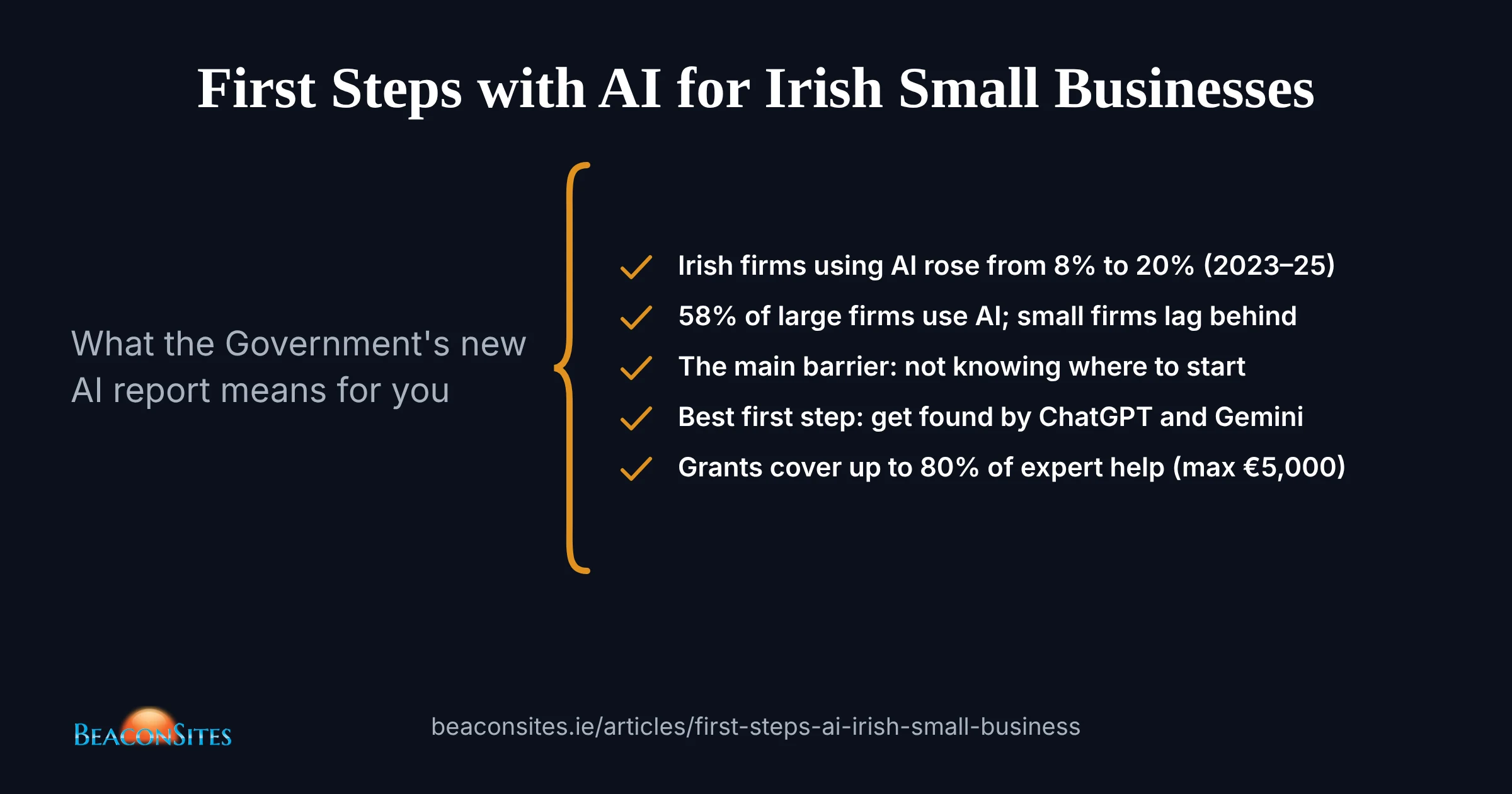
On 13 October 2026, Minister of State Niamh Smyth published A Sectoral Study on Artificial Intelligence in Enterprise in Ireland, prepared by Accenture for the Department of Enterprise, Tourism and Employment.
Its message for small businesses is blunt: AI use "remains much more limited across Ireland's small businesses", and the first hurdle is usually knowing where to start.
What the report found
The study combines official statistics with 272 enterprise consultation responses, interviews with more than 30 stakeholders and four sector workshops with 175 participants. The headline figures:
| Measure | Figure | Source cited in the report |
|---|---|---|
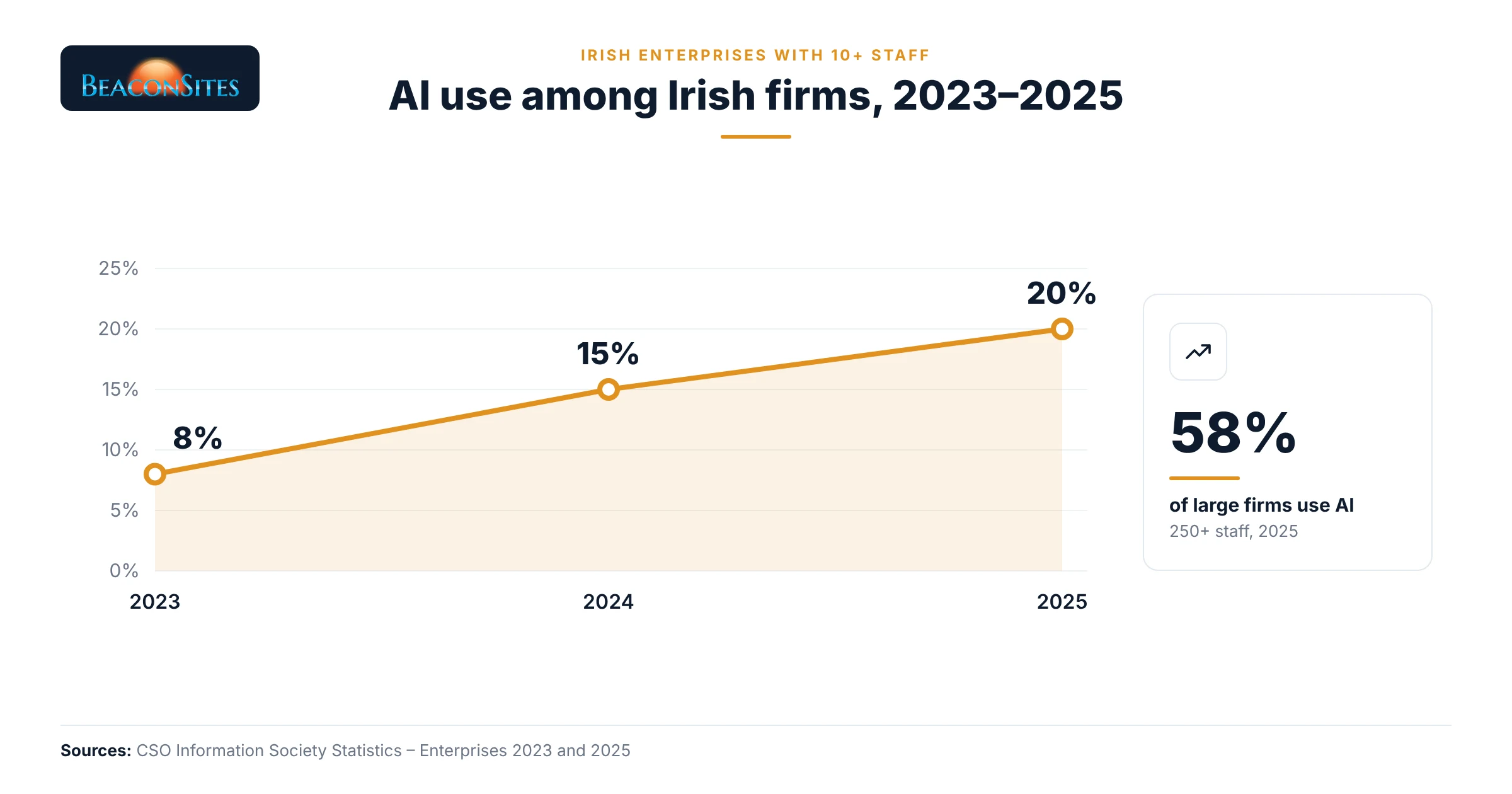
| Irish enterprises (10+ staff) using AI | 8% in 2023 → 20% in 2025 | Official statistics (CSO) |
| Large enterprises using AI | 58% in 2025 | Official statistics (CSO) |
| Workers using generative AI daily at work | 8% in 2024 → 22% in 2026 | Accenture employee survey |
| Micro manufacturing firms with no AI use | 83% (2022–2024) | Micro-enterprise survey |
| Micro construction firms with no AI use | 93% (2022–2024) | Micro-enterprise survey |
| Consultation respondents at task-level use only | About half | Report's own consultation (272 responses) |
| Respondents with a pilot or embedded workflow | 15% | Same |
| Respondents with a scaled or AI-native model | 10% | Same |
The pattern is clear. Large firms are moving, and most small firms are either not using AI or are using it for one-off tasks, like drafting an email in ChatGPT.
The report is also candid about why. Firms "cannot identify the right use case, judge what good looks like or connect AI to business value". For small and medium-sized firms, "the first hurdle may be uncertainty rather than finance". And owner-manager time is often the real constraint.
Its advice for a micro or small firm is modest: "one defined use case, a simple readiness and risk assessment, a clear owner and one practical next step."
Large firms are moving. Most small firms are either not using AI or are using it for one-off tasks.
The half of the AI story the report barely measures
The study looks mostly at AI inside the business: automating work, decision support, productivity. The other half is your customers using AI to decide who to buy from.
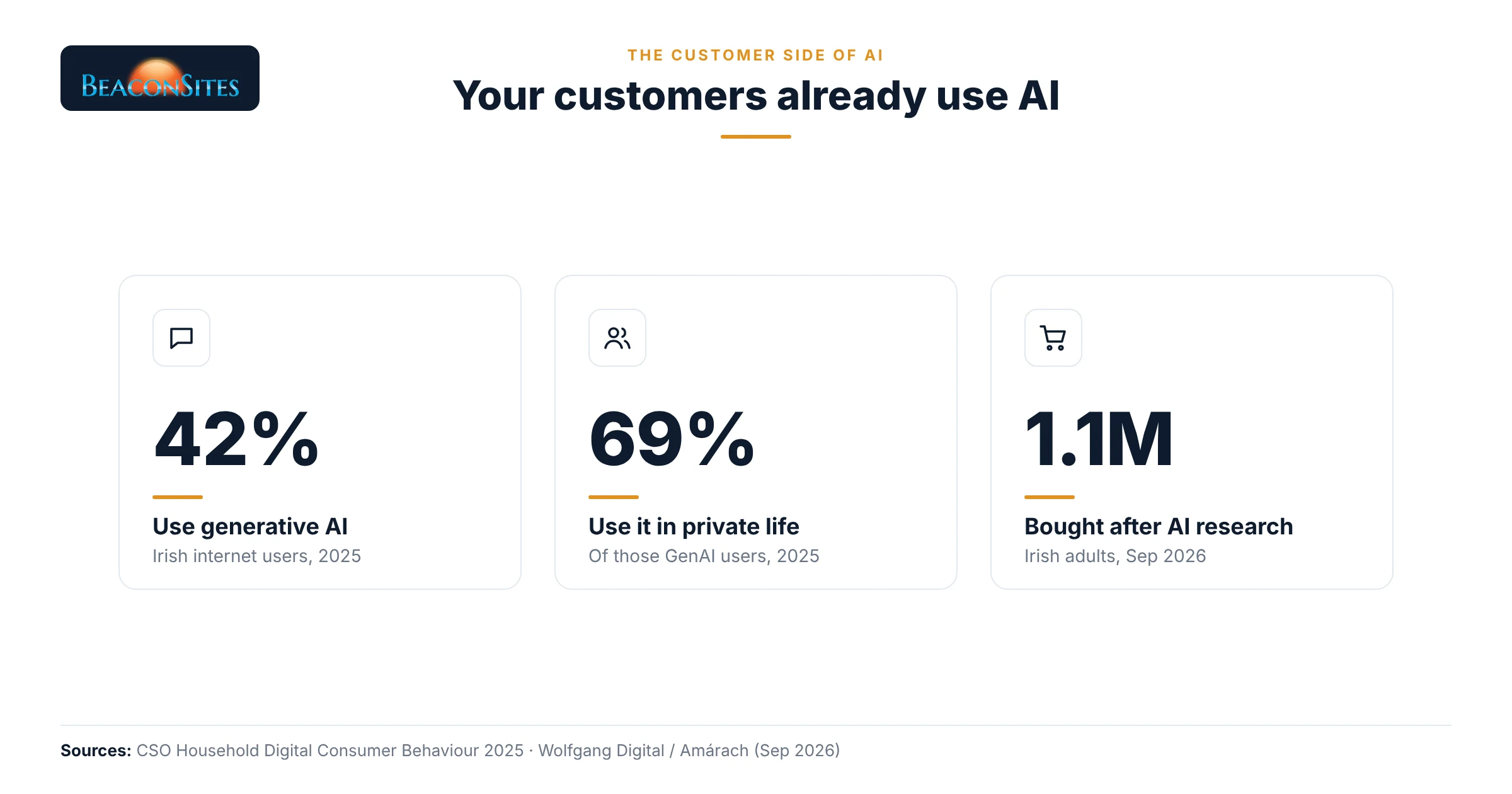
That half is already big in Ireland. According to the CSO, 42% of Irish internet users had used generative AI tools such as ChatGPT or Copilot by 2025, and 69% of those used them in their private lives. Research by Wolfgang Digital and Amárach (1,000 adults, September 2026) takes it a step further: about 1.1 million Irish adults have bought something after researching it with AI.
The report does see this, in its tourism chapter. "AI is becoming another intermediary between visitors and businesses," it says, and small firms "cannot individually influence global platform rules". It recommends pilots that make "accurate, structured" destination and product information easier for AI-enabled discovery to find.
That advice is written for tourism, but it applies to any Irish business whose customers ask an AI assistant for a recommendation: a solicitor, a dentist, a kitchen fitter, a B2B supplier.
The other half of the AI story is your customers using AI to decide who to buy from.
Why visibility is the right first step
It fits the report's own test for a small firm's first AI project:
- One defined use case: be found and correctly described when a customer asks an AI assistant about your service.
- A simple readiness check: you can test it yourself in 30 minutes (below).
- A clear owner and a next step: the fixes sit on your own website, which you already control.
- A visible link to revenue: an AI recommendation leads to an enquiry. Internal tools save time, but the payback is harder to see.
It also avoids the costs the report warns about. You don't need new software, data infrastructure or retraining staff.
Visibility needs no new software, no data infrastructure and no retraining.
Where Government support fits
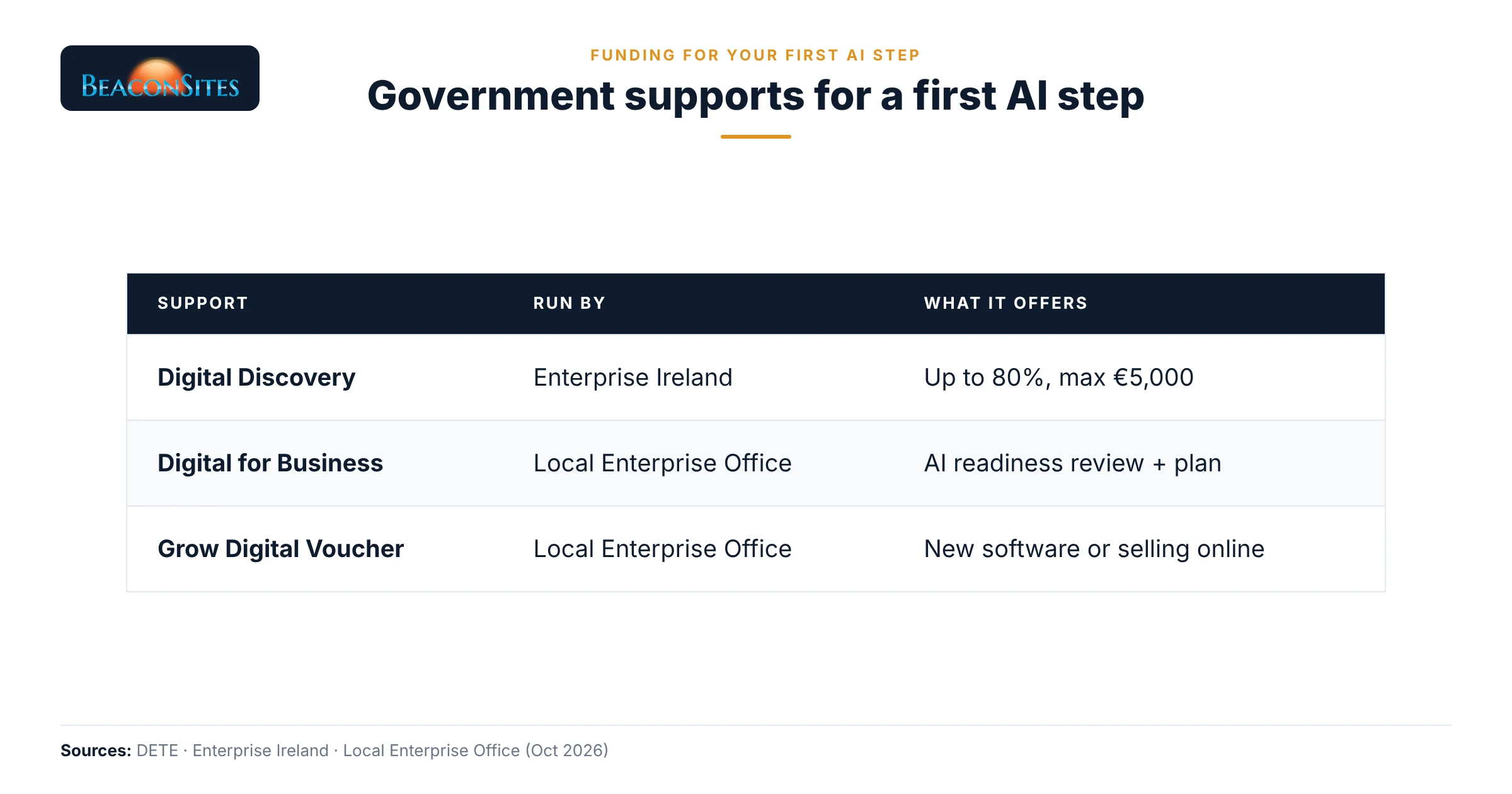
If you want expert help with your first AI step, there is funding for it. The main supports for small firms, as listed by the Department of Enterprise, Tourism and Employment:
| Support | Run by | What it offers |
|---|---|---|
| Digital Discovery | Enterprise Ireland | Up to 80% grant funding, to a maximum of €5,000, to hire an expert to put digital foundations in place or take a first step in AI |
| Digital for Business | Local Enterprise Office | A digital and AI readiness review with a tailored plan |
| Grow Digital Voucher | Local Enterprise Office | Support to introduce new software or sell online, for businesses trading at least six months |
The Government's AI – Good for Business campaign, launched in May 2026, pulls these supports together under a "start small and scale" message. Check eligibility with Enterprise Ireland or your Local Enterprise Office before you apply.
One practical point: a grant pays for help with a defined project. Knowing where you stand in AI search first makes that project easier to define.
A grant pays for help with a defined project. Knowing where you stand in AI search makes that project easier to define.
The 30-minute self-check
Open ChatGPT, Gemini and Microsoft Copilot. Ask each of them these five questions, swapping in your own service and town:
- "Who are the best [service] providers in [town]?"
- "How much does [service] cost in Ireland?"
- "What should I look for when hiring a [service] in [county]?"
- "What is [your business name] and what does it offer?"
- "Is [your business name] or [main competitor] better for [service]?"
Score each answer: named you, named you with errors, or didn't name you. Note which competitors appear and which websites the assistant cites.
Three or more "didn't name you" results mean customers using AI aren't hearing about you. For the engines and how each one picks its sources, see Five AI engines and business citation.
What to fix first
- Answer-first service pages. Open each page with a plain 40–60 word answer to the question a customer asks.
- Prices or price ranges. A stated cost gives an AI assistant a concrete answer to quote.
- Location and service area, written out in text, not only in a map.
- An FAQ on every service page, using the questions from your self-check.
- Structured data (schema) for your business, services and FAQs.
- Consistent business facts across your site, Google Business Profile and directories.
- Mentions on other sites. AI engines often cite what other sites say about you, not just what you say about yourself.
To see whether it's working, track visits from AI assistants in Google Analytics. The BeaconSites guide to detecting AI referral traffic in GA4 shows how.
How quickly this can work
BeaconSites tested this on its own site in July 2026. A new article on its own drew no measurable AI citations in three days.
Once a version was syndicated across 456 news placements, Bing Copilot named BeaconSites its top answer for "best AI visibility audit service Ireland 2026" within 16 hours of submission. The full timeline, including Gemini and ChatGPT, is in the 16-hour AI citation cycle case study.
Mistakes to avoid
- Starting with a tool, not a problem. The report's own top barrier is firms that "cannot identify the right use case". A chatbot on your site doesn't help if AI assistants never send anyone to it.
- Ignoring wrong answers. If ChatGPT gives an old address, wrong prices or a service you don't offer, customers believe it. Fix the facts on your site and listings first.
- Treating it as a one-off. AI answers change as engines update. Re-run the self-check every quarter.
- Writing for robots. Pages that answer customers' questions plainly work better for people and AI engines alike.
If the self-check showed gaps, the BeaconSites AI Visibility Audit does it properly. From €299, it covers five AI engines, your competitors and a ranked fix list, with a 30-minute findings call with founder Lee Graham.
Sources
- A Sectoral Study on Artificial Intelligence in Enterprise in Ireland, Accenture for DETE, 13 October 2026 (PDF)
- Minister Niamh Smyth publishes major report on AI adoption, DETE, 13 October 2026
- Information Society Statistics – Enterprises 2025, CSO, 6 February 2026
- Household Digital Consumer Behaviour 2025 – Generative AI, CSO, 5 December 2025
- One in four Irish shoppers has bought a product on AI's advice, Wolfgang Digital / Amárach, Irish Times advertising feature, 29 September 2026
Data and evidence
| Data point | Value | Source |
|---|---|---|
| Irish enterprises (10+ staff) using AI | 8% in 2023, 15% in 2024, 20% in 2025 | CSO Information Society Statistics – Enterprises |
| Large enterprises (250+ staff) using AI | 58% in 2025 | CSO, cited in DETE sectoral study, Oct 2026 |
| Irish internet users who have used generative AI | 42% (2025); 69% of them in private life | CSO Household Digital Consumer Behaviour 2025 |
| Irish adults who bought after researching with AI | About 1.1 million | Wolfgang Digital / Amárach, Sep 2026 |
| Digital Discovery grant | Up to 80%, max €5,000 | Enterprise Ireland |
Terms used in this article
- AEO (answer engine optimisation)
- Making a website easy for AI assistants to read, trust and quote in their answers.
- AI assistant
- A tool such as ChatGPT, Gemini, Microsoft Copilot or Perplexity that answers questions in plain language.
- Google AI Overviews
- The AI-written summary that appears above Google's normal search results.
- Schema (structured data)
- Code on a web page that labels facts like your business name, services, prices and FAQs for machines.
- Citation
- When an AI assistant names or links to your business as a source in its answer.
- Syndication
- Republishing a piece of content across other websites, such as news and media sites.
Common questions
What does the Government's 2026 AI report say about small businesses?
The Accenture study for the Department of Enterprise, Tourism and Employment, published on 13 October 2026, finds that AI use "remains much more limited across Ireland's small businesses" than in large firms, where 58% used AI in 2025. The main barriers it names are knowing where to start, unclear costs and payback, and owner-manager time.
What is the first AI step a small business in Ireland should take?
Check whether AI assistants such as ChatGPT, Gemini and Copilot can find and correctly describe your business, then fix your website so they can. It needs no new software, it uses a website you already control, and it links directly to enquiries, because Irish customers already use AI to choose suppliers.
How many Irish consumers use AI to choose what to buy?
42% of Irish internet users had used generative AI by 2025, according to the CSO, most of them for personal use. Research by Wolfgang Digital and Amárach published in September 2026 estimates that about 1.1 million Irish adults have bought a product after researching it with AI.
How much does an AI visibility audit cost in Ireland?
The BeaconSites AI Visibility Audit starts at €299 and takes 7–10 working days. It tests 20–30 customer-style questions across ChatGPT, Claude, Perplexity, Google AI Overviews and Microsoft Copilot, reviews your website's AEO readiness and gives a ranked list of fixes.
Is there a grant for AI for small businesses in Ireland?
Yes. Enterprise Ireland's Digital Discovery support offers up to 80% grant funding, to a maximum of €5,000, to hire an expert to take a first step in AI. Local Enterprise Offices also run Digital for Business reviews and the Grow Digital Voucher. Check eligibility with each body before you apply.
How long does it take for a business to appear in ChatGPT or Copilot?
It varies by engine and query. In BeaconSites' own July 2026 test, Bing Copilot ranked BeaconSites first within 16 hours of syndicating an article across 456 news placements, and ChatGPT was citing it by the next check, about 36 hours in. In the same test, the article on BeaconSites' own site produced no measurable citations in its first three days.
Do I need a new website to be found by AI assistants?
Usually not. Most gains come from rewriting key service pages to answer customer questions directly, adding prices or ranges, FAQs and schema, and making your business details consistent everywhere. A rebuild only makes sense if your current site can't be edited or loads badly.
What is answer engine optimisation (AEO)?
AEO is the practice of making your website easy for AI assistants to read, trust and quote. Where SEO aims to rank a page in Google's links, AEO aims to get your business named in the answer itself, in tools like ChatGPT, Gemini, Copilot, Perplexity and Google AI Overviews.
The Government's report confirms what most Irish small business owners already feel: AI is moving fast, and it's hard to know where to begin. Its advice is to start with one small, defined project.
For most small firms, the best candidate is making sure AI assistants can find you, describe you correctly and recommend you. It costs little, it uses the website you already have, and it connects directly to the customers who are already asking ChatGPT, Gemini and Copilot who to call.