
The Five AI Engines That Now Decide Whether Your Business Gets Found
Five AI engines now mediate how customers find and choose businesses: ChatGPT, Claude, Perplexity, Google AI Overviews, and Microsoft Copilot. Each retrieves from different sources, weights different signals, and cites different brands. A business invisible to one engine has lost roughly a fifth of its AI search surface. A business invisible to all five is invisible in 2026.
 By Lee Graham · Published · Updated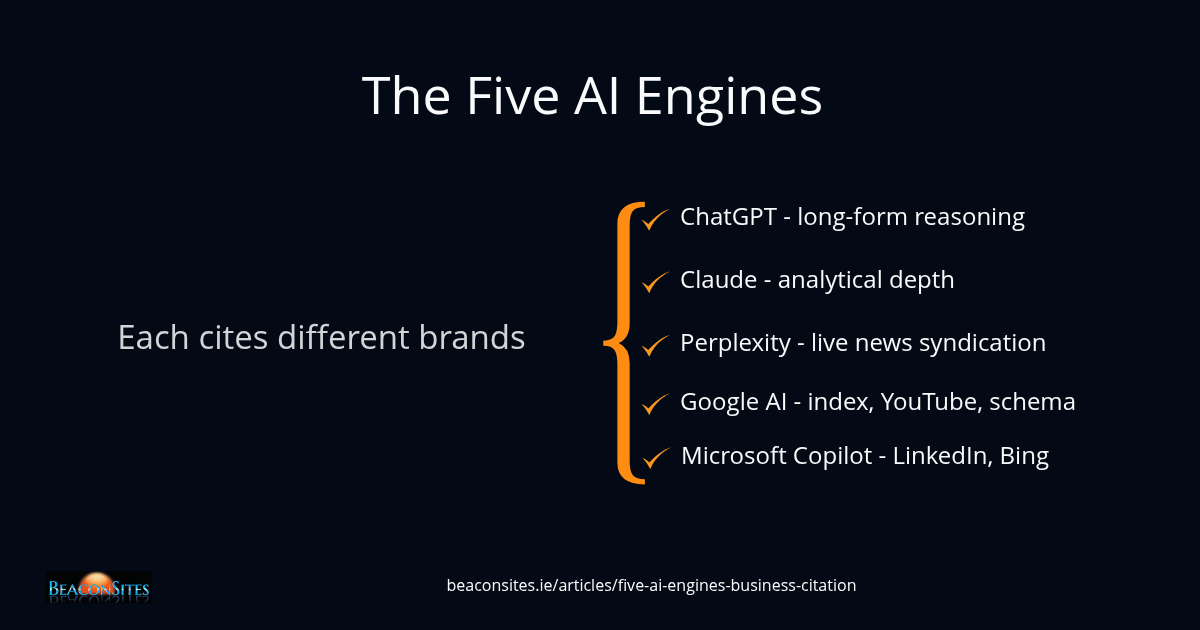
Update — 2026-06-29: Since this article was published, the canonical AI engine set has expanded to seven, adding Gemini and Google AI Mode. The five engines documented below remain core to AI visibility; the two additions are covered in depth in the follow-up — Seven AI Engines for 2026: Why Gemini and Google AI Mode Joined the Canonical Set.
For most of the last twenty-five years, marketing buyers had to worry about one search engine. Google was the gatekeeper. Show up in Google's results, get found by customers. Miss the top of Google's results, lose the customer to whoever was above you.
That single-gatekeeper model ended in 2025. In its place, five distinct AI engines now mediate how customers find and choose businesses. Each engine retrieves content from different sources.
Each weights different signals. Each cites different brands in response to similar queries. A business invisible to one engine has lost roughly a fifth of its AI search surface.
A business invisible to all five is, in operational terms, invisible.
This article documents the five engines, what each retrieves from, what each weights, and what a brand needs to do to be cited by each. The article uses BeaconSites' own AI Visibility Audit framework as the practical lens, because it is the framework we use to test client visibility across all five engines.
For the broader thesis on why this matters, see The Quiet Race to Build Proprietary AI Content Infrastructure. For the metric all five engines are weighting, see What Is Consensus Signal. For the discipline that produces it, see AEO vs SEO.
ChatGPT — the largest AI search engine by usage
ChatGPT is the AI engine that brought conversational search to mainstream usage. By late 2024 it had crossed three hundred million weekly active users; through 2025 it continued accelerating. For brand recommendation queries — "best Dublin marketing agency", "which Irish accountancy practice should I use", "what is the best SaaS tool for X" — ChatGPT now answers a meaningful share of the queries that previously went to Google.
ChatGPT retrieves primarily from text-rich indexed web content. It weights long-form written content heavily. It weights review platform presence heavily.
It weights structured editorial mentions (industry publications, trade press, journalistic citations) heavily. It treats brand mentions in well-corroborated text contexts as strong signal.
To be cited by ChatGPT in recommendation responses, brands need long-form web content engineered with AI-extractable patterns (definition-first paragraphs, FAQ structure, named entities in opening 100 words), active review platform presence on at least two relevant platforms, and structured editorial mentions across multiple independent sources.
The single most important ChatGPT-specific finding from current research is the EMGI analysis of 150 SaaS companies: 81% of brands recommended by ChatGPT do not appear in Google's top 10 for the same query. The ranking-citation decoupling is most pronounced in ChatGPT, which is why brands that have optimised only for Google often discover they are invisible to ChatGPT despite ranking well on traditional search.
The single-gatekeeper Google model ended in 2025. Five distinct AI engines now mediate how customers find and choose businesses, each retrieving from different sources and weighting different signals.
Claude — the analytical AI engine with growing recommendation usage
Claude is the AI engine designed for analytical, reasoning-intensive tasks. It is favoured by buyers conducting deeper research — comparative vendor evaluations, B2B procurement diligence, technical product analysis. Usage is lower than ChatGPT in absolute terms but skews toward higher-value buyer segments.
Claude retrieves from text-rich content sources similar to ChatGPT but weights analytical depth more heavily. It rewards content that provides reasoning, evidence, and structured argument over content that asserts conclusions. It weights citation quality (source authority, recency, specificity) heavily when synthesising answers.
To be cited by Claude in recommendation responses, brands need content that demonstrates reasoning and evidence, not just claims. Articles with structured data evidence (specific statistics, named sources, dated findings), explicit reasoning chains, and complete logical arguments perform better than persuasion-style marketing content. The same pattern applies to review platform content: detailed reviews with specific use-case context weight more heavily than generic five-star summaries.
For B2B businesses and technical product companies, Claude visibility is disproportionately important relative to its raw user count, because the users querying Claude for vendor recommendations are typically further along the buying cycle and have higher individual deal values.
81% of brands recommended by ChatGPT do not appear in Google's top 10 for the same query. Brands optimised only for Google often discover they are invisible to ChatGPT despite ranking well.
Perplexity — the AI engine built around news and structured sources
Perplexity is the AI engine designed from the ground up as a search-first product. It weights news, structured sources, and recently published content more heavily than the conversational AI engines. It is favoured by users looking for current information, breaking developments, and time-sensitive answers.
Perplexity retrieves heavily from news syndication networks, established publishers, and recently indexed content. It weights publication recency, source authority, and citation density when synthesising answers. It typically displays source citations more prominently than other AI engines, which means brands cited in Perplexity responses get more clickable visibility per citation.
To be cited by Perplexity in recommendation responses, brands need ongoing presence in news syndication and trade press. A one-off press release does not build Perplexity visibility. Sustained editorial syndication across networks like Business Insider, AP News, Apple News, Google News, and regional press feeds is what registers in Perplexity's retrieval surface.
This is why distribution layer infrastructure (the third of the three layers of AI-citable content) matters disproportionately for Perplexity visibility. A brand with strong production but no distribution can be invisible to Perplexity while still being cited by ChatGPT and Claude.
Perplexity is built around news and structured sources. Distribution layer infrastructure matters most here. A brand with strong production but no distribution can be invisible to Perplexity while still being cited by ChatGPT.
Google AI Overviews — the AI engine integrated into Google's search
Google AI Overviews is the AI engine integrated into Google's core search product. Unlike the standalone conversational AI engines, AI Overviews appears within the Google search results page, displaying a synthesised answer above traditional ranked listings. As of early 2026, AI Overviews triggers on 48% of all US Google searches, up 58% year-on-year.
AI Overviews retrieves from Google's existing search index. It weights the same factors that influence Google ranking, but it synthesises an answer rather than presenting links. It weights YouTube content particularly heavily, because YouTube is Google-owned and structured for content retrieval at the video level. It weights structured data on the brand's own site, particularly schema markup that matches Google's structured data expectations.
To be cited in AI Overviews, brands need strong on-page SEO foundations (which still matter for retrieval), YouTube presence with proper metadata and structured content, and schema markup on the brand's own site that exposes the brand's facts in machine-readable form. The brands cited in AI Overviews typically have all three.
The structural significance of AI Overviews is that even users who never leave Google are now consuming AI-synthesised answers for nearly half their queries. The click-through rate on traditional ranked results drops from approximately 15% to 8% when an AI Overview appears, according to Pew Research July 2025. SEO investment that depended on capturing clicks from ranked positions has lost roughly half its value on AI Overview queries.
The user base running queries in Outlook or Office tools is exactly the buying-decision audience for B2B services and software. Many marketing teams underinvest in Microsoft Copilot for this reason.
Microsoft Copilot — the AI engine integrated across Microsoft's ecosystem
Microsoft Copilot is the AI engine integrated across Microsoft's product ecosystem: Bing search, LinkedIn, MSN, Outlook, Office. Usage is concentrated among professional and B2B users, particularly in markets where Microsoft's enterprise software footprint is large.
Copilot retrieves primarily from the Bing search index and Microsoft-owned properties. It weights LinkedIn content heavily because LinkedIn is Microsoft-owned. It weights MSN editorial content and Bing-indexed news heavily. For B2B and enterprise buyer queries, Copilot is disproportionately influential because the buyers running queries are often Microsoft-ecosystem users in their professional roles.
To be cited by Copilot in recommendation responses, brands need Bing visibility (which is partly downstream of Google SEO but has Bing-specific factors), LinkedIn presence with consistent brand information, MSN or Bing-indexed editorial mentions, and structured data on the brand's own site that aligns with Microsoft's content understanding model.
Many marketing teams underinvest in Copilot visibility because they assume it is small. For B2B and enterprise businesses, this is often a mistake. The user base running queries in Outlook or Office tools is exactly the buying-decision audience for B2B services and software.
A business invisible to one engine has lost roughly a fifth of its AI search surface. A business invisible to all five is, in operational terms, invisible.
What being cited by all five engines actually requires
The pattern across the five engines is that no single optimisation strategy works for all of them. Each engine weights different signals. A brand that has optimised for ChatGPT may be invisible to Perplexity.
A brand optimised for Perplexity may be missing from Google AI Overviews. A brand optimised for Google AI Overviews may not appear in Copilot.
The brands that appear consistently across all five engines have built infrastructure that addresses every retrieval surface. Long-form content for ChatGPT and Claude. News syndication for Perplexity.
YouTube and schema for Google AI Overviews. LinkedIn and Bing for Copilot. Plus the consensus signal layer across all five — multi-source corroboration, review platform presence, structured business data consistency.
This is why the three-layer infrastructure model (production, transformation, distribution) is not optional for full AI visibility. Single-layer optimisation reaches one or two engines. Multi-layer infrastructure reaches all five.
For Irish SMEs and mid-market businesses, the practical implication is that the AI search visibility question is no longer "which engine should we optimise for". It is "what is our footprint across all five engines, and where are the gaps". The AI Visibility Audit framework BeaconSites uses tests presence across all five engines simultaneously and identifies which gaps matter most for the business's specific buyer profile.
The brands that close those gaps now build a multi-engine moat. The brands that wait will find the moat already built by competitors when they eventually arrive.
Data and evidence
| Data point | Value | Source |
|---|---|---|
| ChatGPT weekly active users (late 2024) | 300 million | OpenAI public disclosures, late 2024 |
| ChatGPT-recommended brands NOT in Google's top 10 (SaaS analysis) | 81% (across 150 SaaS companies) | EMGI SaaS AI Citation Gap Report, 2026 — https://emgigroup.com/blog/saas-ai-citation-gap-report/ |
| Google searches now triggering an AI Overview (US) | 48% (up 58% year-on-year through early 2026) | BrightEdge AI Overviews tracking report, May 2026 — https://www.brightedge.com/news/press-releases/one-year-google-ai-overviews-brightedge-data-reveals-google-search-usage |
| Click-through rate on traditional results when AI Overview appears | 8% (vs ~15% without) | Pew Research, July 2025 — https://www.pewresearch.org/short-reads/2025/07/22/google-users-are-less-likely-to-click-on-links-when-an-ai-summary-appears-in-the-results/ |
| Citation probability uplift — brands with profiles on 2+ review platforms | 3.4× vs brands with none | Seer Interactive / Trustpilot, March 2026 — https://www.seerinteractive.com/news/trustpilot-seer-study-how-review-profiles-impact-brand-ai-visibility |
| Marketing/creative service firms cutting content headcount after AI adoption | 74% (average 22% reduction) | Federal Reserve Q1 2026 survey — https://www.federalreserve.gov/econres/notes/feds-notes/monitoring-ai-adoption-in-the-u-s-economy-20260403.html |
Terms used in this article
- The Five-Engine AI Search Landscape
- The set of five AI engines that collectively mediate how customers find and choose businesses in 2026: ChatGPT, Claude, Perplexity, Google AI Overviews, and Microsoft Copilot. Each retrieves from different primary sources, weights different signals when synthesising answers, and cites different brands in response to similar queries. The five-engine landscape replaced the single-gatekeeper Google search model through the 2025 transition window. A business invisible to one engine has lost roughly a fifth of its AI search surface; invisibility across all five equates to operational invisibility in 2026.
- Engine-Specific Retrieval Bias
- The observation that each of the five AI engines retrieves content from a partially distinct set of sources and weights signals differently when synthesising answers. ChatGPT and Claude weight long-form text-rich content heavily. Perplexity weights news syndication and recently published content. Google AI Overviews weights Google's index plus YouTube. Microsoft Copilot weights Bing plus Microsoft-owned properties (LinkedIn, MSN). The practical implication is that no single optimisation strategy reaches all five engines; multi-layer infrastructure addressing every retrieval surface is required.
- The Multi-Engine Moat
- The compounding strategic advantage accumulated by brands that achieve consistent visibility across all five AI engines simultaneously. Once established, the moat is difficult for competitors to cross because it requires building infrastructure across multiple retrieval surfaces in parallel, each of which takes time to compound. The moat compounds for two to three years before saturating, which means brands that build it during the 2026-2027 window establish positions that late entrants cannot easily contest. The five-engine moat is the AI-era equivalent of brand-name domain authority on Google in the 2010s.
Common questions
Why are there five AI engines I need to worry about, not just one?
The single-gatekeeper Google model ended in 2025. Through that year, ChatGPT crossed 300 million weekly users, Perplexity, Claude, and Microsoft Copilot saw step-change usage growth, and Google integrated AI Overviews into 48% of all US searches. By the end of 2025, customers were getting recommendations from five distinct AI engines — each with different retrieval sources and weighting.
A business invisible to one engine has lost roughly a fifth of its AI search surface. A business invisible to all five is, in operational terms, invisible.
Which AI engine is most important for my business?
It depends on your buyer profile. For consumer-facing local businesses, ChatGPT and Google AI Overviews dominate. For B2B and technical product companies, Claude and Microsoft Copilot are disproportionately influential despite lower raw user counts.
For businesses dependent on time-sensitive discovery (events, news-related products, current developments), Perplexity matters most. The AI Visibility Audit BeaconSites uses tests presence across all five engines and identifies which gaps matter most for the business's specific buyer profile.
What does ChatGPT specifically look for when recommending brands?
ChatGPT weights long-form web content with AI-extractable patterns (definition-first paragraphs, FAQ structure, named entities in opening 100 words), active review platform presence on at least two relevant platforms, and structured editorial mentions across multiple independent sources. The single most important ChatGPT-specific finding: 81% of brands ChatGPT recommends do not appear in Google's top 10 for the same query (EMGI 2026 SaaS analysis). Brands that have optimised only for Google often discover they are invisible to ChatGPT despite ranking well on traditional search.
How is Perplexity different from the other AI engines?
Perplexity is built around news and structured sources rather than conversational interaction. It weights news syndication networks, established publishers, and recently published content more heavily than ChatGPT or Claude. It typically displays source citations more prominently, which means brands cited in Perplexity responses get more clickable visibility per citation.
To be cited by Perplexity, brands need ongoing presence in news syndication (Business Insider, AP, Apple News, Google News, regional press) — not just a one-off press release. Distribution layer infrastructure matters most here.
Does Google AI Overviews replace SEO?
Partially. AI Overviews retrieves from Google's existing search index, so traditional SEO factors still matter for retrieval. But AI Overviews synthesises an answer rather than presenting links, which means the citation pattern matters more than the ranking position.
Click-through rate on traditional ranked results drops from approximately 15% to 8% when an AI Overview appears (Pew Research July 2025). The practical implication is that SEO investment depending on capturing ranked-position clicks has lost roughly half its value on AI Overview queries. To be cited in AI Overviews, brands need strong on-page SEO, YouTube presence with proper metadata, and schema markup matching Google's structured data expectations.
Why should I care about Microsoft Copilot if my customers are mostly on Google?
For B2B and enterprise businesses, your customers spend significant working hours inside Microsoft tools — Outlook, Office, Teams, LinkedIn. Copilot is integrated across all of these. When a procurement manager researches vendors from inside their work environment, Copilot is the AI engine answering.
Microsoft Copilot weights LinkedIn (Microsoft-owned), MSN editorial, and Bing-indexed content. Many marketing teams underinvest in Copilot visibility because they assume usage is small. For B2B audiences, this is often a strategic mistake — the buyers running queries in Office tools are exactly the buying-decision audience for B2B services and software.
The single-gatekeeper Google era ended in 2025. Five AI engines now mediate how customers find and choose businesses. Each weights different signals.
Each retrieves from different sources. Each cites different brands. The brands that appear consistently across all five have built multi-layer infrastructure that addresses every retrieval surface — and the consensus signal layer underneath that compounds across all of them.
For Irish SMEs and mid-market businesses, the practical implication is that AI visibility is no longer a question of optimising for one engine. It is a question of operating across all five at meaningful intensity. The brands that close those gaps now build a moat that compounds for two to three years. The brands that wait will find the moat already built by competitors when they eventually arrive.
If you want to know exactly where your business currently stands across all five engines, the AI Visibility Audit tests your footprint against ChatGPT, Claude, Perplexity, Google AI Overviews, and Microsoft Copilot — and identifies which gaps matter most for your specific buyer profile. If you have concluded that operating across all five engines requires the three-layer infrastructure to be in motion, the AEO Content Creation & Syndication service is the operational answer.