
What Is Consensus Signal — And Why It's the New Currency of AI Search
Consensus signal is corroborated information about a brand or topic across multiple independent sources. AI engines like ChatGPT, Claude, Perplexity, Google AI Overviews, and Microsoft Copilot use it to decide which businesses to cite in their answers. Brands without consensus signal stay invisible in AI search, regardless of how well they rank on Google.
 By Lee Graham · Published · Updated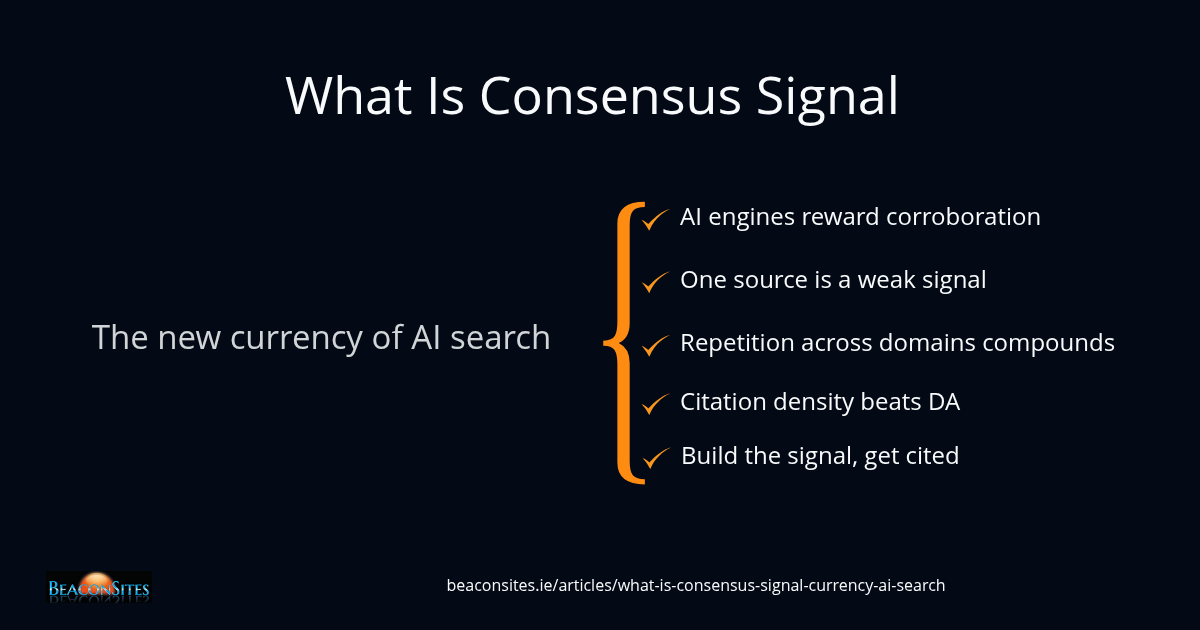
A brand can rank on the first page of Google and still be invisible when a customer asks ChatGPT for a recommendation. The two systems no longer share the same rulebook.
Traditional search ranks pages. AI search synthesises answers. The difference matters because ranking rewards single-page authority — strong content on a single site with strong inbound links.
AI citation rewards something different: corroboration. Multiple independent sources describing the same brand with the same facts, in ways an AI engine can verify against itself.
The technical name for what AI engines look for is cross-source corroboration. The operational term agencies are starting to use is consensus signal. It is the single most important AEO concept of 2026 — and the one most marketing buyers have not yet internalised.
This article defines consensus signal, explains how AI engines measure it, and walks through what the recent research actually shows. For the broader strategic context — why marketing agencies are restructuring around content infrastructure that produces consensus signal at scale — see the foundation article: The Quiet Race to Build Proprietary AI Content Infrastructure.
Consensus signal, defined
Consensus signal is corroborated information about a brand or topic across multiple independent sources that agree on the same facts. AI engines treat it as a primary input when deciding which brands to cite.
The mechanic is straightforward. When ChatGPT, Claude, Perplexity, Google AI Overviews, or Microsoft Copilot is asked a question with a brand-recommendation answer — "who is the best plumber in Drumcondra", "which Dublin marketing agency builds AI-ready websites", "what is the most reliable accountancy practice in Sandyford" — the AI engine does not run a single ranked query. It synthesises the answer from many sources, weighted by how consistently those sources agree.
A brand that appears in one source gets weighted lightly. A brand that appears in many sources, with the same business name, the same description of services, the same operating geography, the same review pattern, gets weighted heavily. That weighting is consensus signal.
The distinction from Google ranking is real and measurable. Google ranks a page. AI engines weight an entity.
A business cannot rank as itself — only its pages can rank. A business can absolutely accumulate or fail to accumulate consensus signal as itself, regardless of which page rank.
Traditional search ranks pages. AI search synthesises answers. The difference matters because ranking rewards single-page authority. AI citation rewards corroboration.
Why AI engines weight corroboration above single-source authority
The reason traces back to how large language models were trained. AI engines are statistical engines. They reward what is most consistently true across their training data, not what is asserted most loudly by any single source.
When a brand has a single website, with all of its facts on that website, an AI engine has one data point. It cannot verify the brand's claims against other sources. The brand's existence and identity are weakly supported in the model's representation.
When a brand has profiles on five different review platforms, has been mentioned in three independent industry publications, has a Wikipedia entry, has structured data on its own site that matches the structured data on third-party listings, and has consistent NAP information (name, address, phone) across all of these — the AI engine has many corroborating data points. The brand's identity is strongly supported.
Strongly supported brands get cited. Weakly supported brands get omitted, even when their own website is technically superior to those of their competitors.
This is a different game from SEO, and it is being played by different rules. SEO rewards engineering on the brand's own property. AEO rewards engineering on the brand's footprint across the open web.
Consensus signal is corroborated information about a brand across multiple independent sources that agree on the same facts. AI engines use it to decide which brands to cite.
What the research shows
Three findings from 2026 quantify how consensus signal operates in practice.
The first comes from a study by review platform Trustpilot in partnership with Seer Interactive, published Q1 2026. The study analysed how often brands with active customer review profiles get cited by ChatGPT versus brands without. Brands with active profiles on at least two independent review platforms (G2, Capterra, Trustpilot, or similar) had a 3.4× higher citation probability than brands with none. Even a single profile produced a 3× lift.
The second comes from EMGI's analysis of 150 SaaS companies, also from 2026. The headline finding: 81% of brands recommended by ChatGPT do not appear in Google's top 10 results for the same query. The ranking system and the citation system are partially decoupled. A SaaS company can lose on Google and still win on ChatGPT, provided its consensus signal is strong.
The third is a structural observation from BrightEdge's May 2026 AI Overviews tracking report: AI Overviews now trigger on 48% of all Google searches in the US, up 58% year-on-year. Even within the Google ecosystem itself, the citation pathway is overtaking the ranking pathway for nearly half of all queries.
Taken together, the research describes a search environment in which a brand's visibility is increasingly determined by how often it is corroborated across the open web, not by how hard it has worked on its own site.
SEO is engineering on the brand's own website. Consensus signal is engineering across the open web. SEO gets pages ranked. Consensus signal gets entities cited.
Where consensus signal actually accumulates
Consensus signal is not a single technical tactic. It accumulates across five distinct surfaces, each one a separate engineering job.
The first surface is structured business data. Google Business Profile, Apple Maps, Bing Places, OpenStreetMap, industry directories, citation aggregators (Yext, Whitespark, Moz Local). When the same business name, address, phone number, and operating hours appear consistently across these surfaces, AI engines treat the brand's identity as verified.
The second surface is customer review platforms. G2, Capterra, Trustpilot, Google Reviews, sector-specific review platforms. Active, recent, multi-source review activity is one of the strongest consensus signal inputs documented in the current research.
The third surface is third-party editorial mentions. Industry publications, trade press, news syndication networks, podcasts that cite the brand, expert roundups, comparative reviews. These do not need to be marketing-pushed — earned mentions weight more heavily than placed ones, because AI engines can detect the difference.
The fourth surface is schema and structured data on the brand's own site, calibrated to match the structured data on third-party listings. LocalBusiness schema, Organization schema, FAQPage schema, Person schema for founders. When the brand's own structured data corroborates third-party structured data, the AI engine has a verifiable chain of agreement.
The fifth surface is multi-format content syndication. Articles, video, podcasts, news releases, infographics — each of these distributed to channels AI engines actually retrieve from. One piece of content becomes eight or ten outputs across distinct platforms, each one another corroborating data point.
A brand that has worked on only one of these surfaces is fragile. A brand that has worked on all five is well on its way to consensus signal at scale.
81% of brands recommended by ChatGPT do not appear in Google's top 10 for the same query. The ranking system and the citation system have partially decoupled.
The fastest practical starting point for an SME
Most small and mid-sized businesses, when first confronting consensus signal, ask the same practical question: where do I actually start?
The honest answer is not "everywhere at once". It is to fix the three surfaces that are most often broken before adding new ones.
The first is structured business data consistency. NAP information (name, address, phone) needs to be identical across Google Business Profile, Bing Places, Apple Maps, and the top sector-specific directories for the business's industry. One inconsistency — a hyphen in a phone number on one platform but not on another — is enough to weaken the consensus signal at the foundation.
This is a one-off audit and cleanup job. It is not glamorous and it is not expensive, but the lift in AI citation probability per hour invested is higher here than almost anywhere else.
The second is the review-platform footprint. If a business has zero review presence on the platforms its customers actually use, building one is the highest-leverage AEO investment available. The 3× citation uplift documented in the Trustpilot/Seer research is real and measurable.
The third is the brand's own structured data. Many SME websites in 2026 still ship without LocalBusiness, Organization, FAQPage, or Person schema. Without these, an AI engine has no machine-readable confirmation of who the business is or what it does, regardless of how clear the human-readable content is.
These three together — NAP consistency, review platform presence, and structured data on the site — are the consensus signal floor. Everything else builds on top of them.
Consensus signal is the entry ticket. The fundamentals of running a business decide what happens once the ticket has been collected.
What consensus signal does not replace
Consensus signal is not a replacement for the marketing fundamentals. It sits beside them, with a different job.
A business with strong consensus signal but a poorly converting website still loses customers. A business that gets cited by ChatGPT but cannot close a sale on the phone or in the meeting room still does not grow. The economics of attention have shifted, but the economics of trust at the point of decision have not.
What consensus signal does is move the brand into the answer set. Without it, the brand is not considered at all by the AI engines that increasingly mediate which businesses customers even hear about. With it, the brand is in the conversation. What happens next is still about the offer, the price, the website, and the human follow-through.
The simplest way to think about it: consensus signal is the entry ticket. The fundamentals of running a business decide what happens once the ticket has been collected.
Data and evidence
| Data point | Value | Source |
|---|---|---|
| Citation probability uplift — brands with one review platform profile | 3× vs brands with none | Seer Interactive / Trustpilot, March 2026 — https://www.seerinteractive.com/news/trustpilot-seer-study-how-review-profiles-impact-brand-ai-visibility |
| Citation probability uplift — brands with profiles on 2+ review platforms | 3.4× vs brands with none | Seer Interactive / Trustpilot, March 2026 — https://www.seerinteractive.com/news/trustpilot-seer-study-how-review-profiles-impact-brand-ai-visibility |
| ChatGPT-recommended brands NOT in Google's top 10 (SaaS analysis) | 81% (across 150 SaaS companies) | EMGI SaaS AI Citation Gap Report, 2026 — https://emgigroup.com/blog/saas-ai-citation-gap-report/ |
| Google searches now triggering an AI Overview (US) | 48% (up 58% year-on-year through early 2026) | BrightEdge AI Overviews tracking report, May 2026 — https://www.brightedge.com/news/press-releases/one-year-google-ai-overviews-brightedge-data-reveals-google-search-usage |
| Click-through rate on traditional results when AI Overview appears | 8% (vs ~15% without) | Pew Research, July 2025 — https://www.pewresearch.org/short-reads/2025/07/22/google-users-are-less-likely-to-click-on-links-when-an-ai-summary-appears-in-the-results/ |
| Typical time to first measurable AI citation movement after fixing the three-surface floor | 60-120 days | BeaconSites client engagements, 2025-2026 (internal data, multiple Irish SME case studies) |
Terms used in this article
- Consensus Signal
- Corroborated information about a brand or topic across multiple independent sources that agree on the same facts. AI engines use it as a primary input when deciding which brands to cite in their answers. Unlike Google ranking (anchored to a single page on a single site), consensus signal is an emergent property of being well-corroborated across the open web — the more independent sources describing the same entity with the same facts, the higher the citation probability.
- Cross-Source Corroboration
- The academic term for what AI engines measure when synthesising answers. Cross-source corroboration is the degree to which multiple independent sources agree on the same facts about an entity. AI engines reward high corroboration with higher citation probability because corroborated information is more verifiable than single-source claims.
- The Three-Surface Floor
- The minimum-viable consensus signal foundation for an SME: (1) NAP (name, address, phone) consistency across Google Business Profile, Apple Maps, Bing Places, and top sector directories; (2) active presence on at least two relevant review platforms; (3) LocalBusiness, Organization, and FAQPage schema on the brand's own website that corroborates the third-party listings. The three-surface floor is the consensus signal foundation; content syndication and earned editorial mentions multiply the effect on top of it.
Common questions
What is consensus signal in simple terms?
Consensus signal is the same facts about a business appearing across multiple independent sources. Google Business Profile, review platforms, industry publications, third-party listings — when these all describe the business consistently, AI engines treat the business as a verified entity and become much more likely to cite it in answers. Consensus signal is corroboration at scale, not strength at any single source.
How is consensus signal different from SEO?
SEO is engineering on the brand's own website — content, on-page signals, internal linking, technical structure. Consensus signal is engineering across the open web — review platform presence, third-party citations, structured business data consistency, schema alignment. SEO gets pages ranked.
Consensus signal gets entities cited. The two practices share some techniques (schema, structured data) but optimise for different outcomes.
How do AI engines actually measure consensus signal?
AI engines aggregate information about a business from many sources during answer synthesis. The more independent sources describe the same entity with the same facts, the more confident the AI engine becomes in that entity's identity and the more likely it is to be cited. Multi-source agreement on business name, address, contact details, service descriptions, review patterns, and editorial mentions all feed the weighting. There is no single observable score — consensus signal is an emergent property of being well-corroborated, not a metric a business can read off a dashboard.
What is the minimum number of sources needed for consensus signal to work?
Research on review platforms suggests an effective floor of two. Brands with active profiles on at least two independent review platforms had a 3.4× higher citation probability in ChatGPT than brands with none, compared to 3× for one platform alone. Beyond review platforms, the broader the multi-source footprint — structured business data, third-party editorial, content syndication — the stronger the consensus signal. There is no upper bound where additional sources stop helping.
Can a business fake consensus signal by paying for placements?
AI engines weight earned mentions more heavily than placed ones, and they can detect the difference at scale. Paid press releases, low-quality directory submissions, and obvious link-building campaigns produce weak consensus signal. Real consensus signal is built through legitimate third-party recognition: organic review activity, earned editorial mentions, structured data that matches reality, and content syndication via established networks. The shortcuts that worked in 2015-era SEO do not work in 2026-era AEO.
What is the fastest way to start building consensus signal for an SME?
The three-surface floor: (1) make NAP information identical across Google Business Profile, Apple Maps, Bing Places, and top sector directories; (2) build presence on the review platforms your customers actually use; (3) deploy LocalBusiness, Organization, and FAQPage schema on your website that corroborates the third-party listings. These three are the consensus signal foundation. Once they are in place, content syndication and third-party editorial mentions multiply the effect. Most SMEs see measurable AI citation movement within 60-120 days of fixing the three-surface floor.
Consensus signal is the metric that decides which brands get found in 2026. The brands AI engines cite are the brands corroborated across the open web. Brands without consensus signal are not cited, and they are not in the customer's consideration set, regardless of how well they rank on Google or how strong their own website is.
For Irish SMEs, the practical implication is that consensus signal is reachable. It does not require the budgets of a multinational. It requires the discipline of getting the three-surface floor right — NAP consistency, review platform presence, structured data — and then building from there with content syndication and earned editorial mentions.
The brands that start now are accumulating citation probability that compounds for the next two to three years. The brands that wait will eventually have to catch up against competitors with multi-year head starts.
If you want to see exactly where your business stands today across the five surfaces of consensus signal, the AI Visibility Audit tests your current footprint across ChatGPT, Claude, Perplexity, Google AI Overviews, and Microsoft Copilot. If you have already decided the question is not whether you need consensus signal but how to build it at scale, the AEO Content Creation & Syndication service is the engineering side of the answer.