
The Three Layers of an AI-Citable Content Strategy
AI-citable content depends on three connected layers, not three independent tactics. Production engineers content for AI extraction. Transformation reformats it for the surfaces different AI engines retrieve from. Distribution publishes each format to channels AI engines actually look at. Get one layer wrong and the whole strategy collapses.
 By Lee Graham · Published · Updated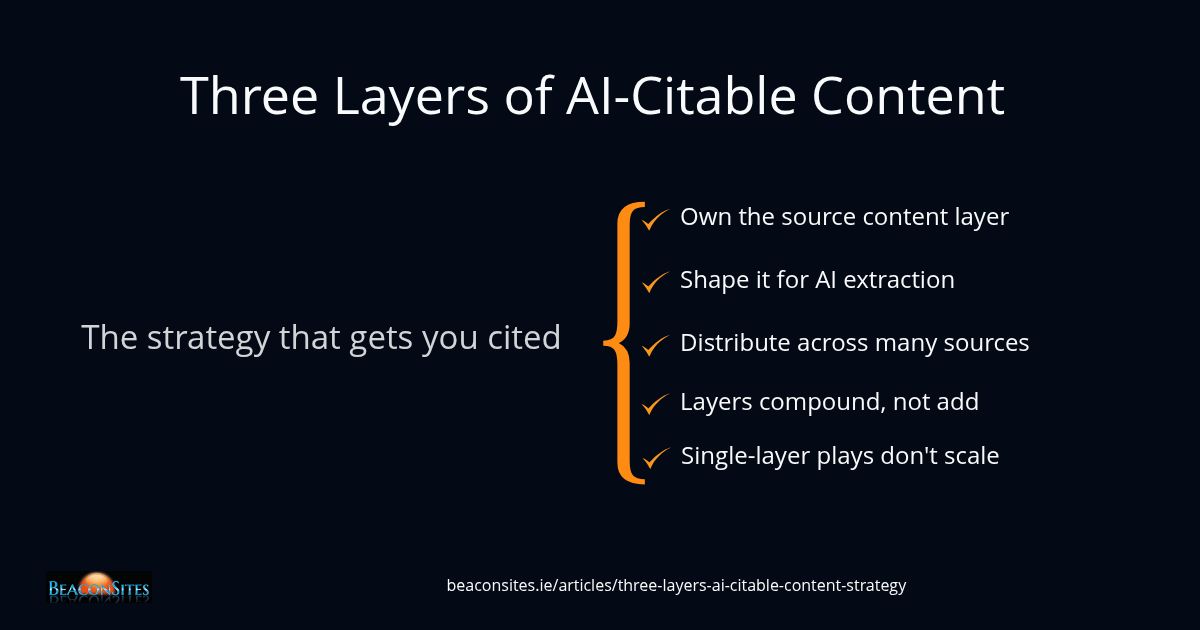
The most common mistake businesses make when investing in AI visibility is treating it as a content marketing decision. Hire a content marketer, publish more articles, do some keyword research, see what sticks. That approach worked for SEO. It does not work for AEO.
Getting cited by ChatGPT, Claude, Perplexity, Google AI Overviews, or Microsoft Copilot is the outcome of an engineered system, not a content output. The system has three connected layers: production, transformation, and distribution. The output of each layer is the input to the next. Break the chain at any point and the strategy stops working.
This article documents the three layers, explains why each one matters, and provides a practical test for evaluating whether your current marketing investment covers all three or leaves most of the leverage on the table.
For the broader thesis on why marketing agencies are restructuring around this model, see The Quiet Race to Build Proprietary AI Content Infrastructure. For the metric all three layers are engineered to produce, see What Is Consensus Signal.
The first layer: production engineered for citation
The production layer is where content is created. The work that happens here looks superficially similar to traditional content marketing but is engineered against different patterns.
AI-citable content is structured for extraction. Definition-first paragraphs lead with explicit definitions ("Consensus signal is corroborated information across multiple sources"). Single-fact-per-sentence chunking means each sentence carries one extractable fact rather than three compound claims.
FAQ structure means questions are formatted as H2 or H3 headings with self-contained answers below. Named entities appear in the opening 100 words rather than buried in paragraph four. Summary tables replace prose comparisons because tables extract more cleanly into AI engine responses.
The economics of the production layer also differ from traditional content marketing. A small agency producing one well-engineered AEO article per week with the right structural patterns can outperform a much larger team producing daily blog posts that follow 2018-era SEO conventions. The work is not about volume. It is about producing content that AI engines can extract from cleanly and confidently cite.
The production layer is where most marketing investments stop. A business commissions content, publishes it on its own website, and assumes the work is done. It is not. Production is only the first of three layers, and a great article published only on the brand's own site reaches a fraction of its potential citation surface.
Getting cited by AI engines is the outcome of an engineered system, not a content output. The system has three connected layers. Break the chain at any point and the strategy stops working.
The second layer: transformation into multi-format outputs
The transformation layer takes one piece of production-layer content and reformats it for multiple distinct distribution surfaces. The same underlying article becomes a news release, a long-form video, a short-form vertical video, a podcast episode, a slide deck, an infographic, a series of social posts, and a syndicated news article.
The reason this matters is that different AI engines retrieve from different surfaces. ChatGPT and Claude are heavily text-trained and weight long-form written content. Perplexity weights news and structured sources.
Google AI Overviews weights indexed web content plus YouTube. Microsoft Copilot weights the Bing index plus Microsoft properties including LinkedIn. A brand that publishes only long-form articles on its own website is visible to ChatGPT and Claude but invisible to the others.
The opposite is also true: brands that produce only short-form social content are invisible to the AI engines that retrieve from long-form sources.
Transformation is where most in-house marketing operations underinvest. Writing one piece of content is hard. Reformatting it into eight or ten distinct formats, each one engineered correctly for its distribution channel, is the kind of operational work that requires either dedicated infrastructure or significant ongoing manual effort. Most SME marketing teams do not have either.
The transformation layer is what turns one production output into eight or ten corroborating data points. A single article that gets reformatted properly becomes eight separate AI engine inputs. The same article posted only to the brand's own website is one input.
Production is only the first of three layers. A great article published only on the brand's own site reaches a fraction of its potential citation surface.
The third layer: distribution to channels AI engines actually retrieve from
The distribution layer publishes each transformation-layer output to the channel where AI engines actually retrieve content from. The work is logistical rather than creative, but the choice of channels determines whether the upstream production and transformation work translates into citations.
News articles need to reach news syndication networks. Business Insider, AP News, Apple News, Google News, and the regional news networks that feed indexed news content into the systems AI engines retrieve from. A news release published only to the brand's own newsroom page does not enter the news syndication index. The brand has produced the asset but has not put it where the AI engines look.
Video needs to reach YouTube and Vimeo at minimum. Short-form video needs to reach TikTok, Instagram Reels, and YouTube Shorts. Podcasts need to reach Apple Podcasts and Spotify.
Slide content needs to reach SlideShare or similar. Social posts need to reach LinkedIn for B2B and X for broader visibility. Infographics need to reach Pinterest and the design-aggregation networks.
Each channel feeds different AI engines. Each format published to its correct channel becomes another corroborating data point. A brand with one article on its own website and zero distribution has one data point.
A brand with one article transformed into eight formats and each one distributed to its appropriate channel has nine data points (the original plus eight derivatives). The compounding effect on consensus signal is significant.
The distribution layer is the most logistically demanding of the three. It is also the layer where buying versus building matters most. Building distribution infrastructure (publishing relationships with syndication networks, automated workflow tools, content adaptation pipelines) is a significant upfront investment. Most agencies that have invested in distribution infrastructure protect access to it as proprietary IP.
A brand that publishes only long-form articles on its own website is visible to ChatGPT and Claude but invisible to the others. A brand that produces only short-form social content is invisible to the AI engines that retrieve from long-form sources.
Why the three layers must connect: the chain principle
The three layers are connected, not independent. Each layer's output is the next layer's input. Breaking the chain at any layer collapses the whole strategy.
A brand that produces great content but does no transformation reaches one channel: its own website. The production work is real but the distribution surface is one-tenth what it could be.
A brand that produces content and transforms it but does no distribution has produced great assets and parked them. The transformed formats sit on the brand's own site without reaching the channels AI engines retrieve from. The work has been done; the leverage has not been captured.
A brand that does transformation and distribution without strong production layer work produces thin content across many channels. The footprint is broad but shallow. AI engines reading the content do not find substantive material to cite.
The three layers multiply each other. They do not add. A 10x production layer combined with a 1x transformation layer and a 1x distribution layer produces a 10x outcome.
The same 10x production layer combined with a 5x transformation layer and a 5x distribution layer produces a 250x outcome. The compounding is real and measurable.
This is why the "do a bit of everything" approach to AEO does not work. A brand investing 10% of its effort across all three layers produces a 0.1% outcome (0.1 × 0.1 × 0.1 = 0.001). The same brand investing 100% in any single layer produces a 100% × 0 × 0 = 0 outcome. The three layers have to be operating together at meaningful strength for any of them to produce meaningful results.
The three layers multiply each other. They do not add. A 10× production layer combined with a 1× transformation and 1× distribution produces 10×. The same production combined with 5× transformation and 5× distribution produces 250×.
What this looks like operationally at SME scale
Most small and mid-sized businesses cannot build all three layers in-house. Production requires dedicated editorial capacity engineered for AEO patterns. Transformation requires the kind of multi-format design and adaptation capacity that typically lived inside large content marketing teams. Distribution requires established relationships with syndication networks and the technical infrastructure to publish across formats efficiently.
For an Irish SME, there are two practical paths to operating across all three layers.
The first is partnership with an agency that has invested in proprietary infrastructure across all three layers. This is the more common path. A monthly retainer with an agency that operates production, transformation, and distribution as integrated services means the brand gets the full three-layer effect without building the infrastructure itself. BeaconSites currently delivers this as the AEO Content Creation & Syndication service from €999 per month, producing AEO-engineered articles via Carvium (the 16-agent in-house content pipeline) and distributing across 300 to 800 high-traffic publishers monthly via MediaCastHub (the in-house distribution entity).
The second is building proprietary infrastructure in-house. This path makes sense for businesses with significant content marketing budgets that prefer to bring the capability inside. The build cost is substantial.
Production tooling and editorial capacity is one investment. Transformation pipelines (typically using a combination of AI tools and design automation) is another. Distribution infrastructure (syndication network relationships, multi-channel publishing workflows) is the heaviest.
The total investment for a real three-layer in-house build is typically multiple six figures over twelve to eighteen months, depending on the level of automation involved.
For most SMEs, the partnership path produces faster results at lower cost. Building in-house makes sense for larger businesses where the marketing infrastructure becomes a strategic asset in its own right.
Any agency or proposal that cannot describe its production patterns, transformation output count, and distribution publisher reach is selling Layer 1 partial-coverage marketing with AEO branding.
The three-layer test for evaluating any marketing investment
The most useful practical takeaway from this framework is a buyer evaluation tool: the three-layer test. When evaluating an agency pitch, a content marketing retainer, or a proposed in-house build, ask which of the three layers the investment actually covers.
A blog-post-only investment covers Layer 1 (production) at low intensity. A typical content marketing retainer covers Layer 1 plus light Layer 3 distribution (the agency posts to the client's social channels). A real AEO infrastructure investment covers all three layers at meaningful intensity.
Three questions to put to any agency or proposal during evaluation.
First, what is your production process and what AEO-extraction patterns does it use. An agency that cannot articulate which extraction patterns its content is engineered for is operating at Layer 1 weakly. An agency that can describe definition-first paragraph structure, single-fact-per-sentence chunking, FAQ structure for schema, and named-entity placement is operating at Layer 1 properly.
Second, what is your transformation process and how many distinct output formats do you produce per source piece. An agency that only produces blog posts is doing no Layer 2 work. An agency that systematically transforms each source piece into 8-10 formats has built Layer 2 infrastructure. The number matters because it correlates directly with distribution surface area.
Third, what is your distribution process and how many publishers does the average piece reach. An agency that publishes only to the client's own site has no Layer 3 distribution. An agency that reaches 100 to 800 publishers monthly is operating real Layer 3 infrastructure. This number is the most concrete measure of AEO investment, because distribution reach is the hardest layer to fake.
An investment that passes all three tests is real AEO infrastructure. An investment that only passes one or two is incomplete and will not produce the citation outcomes AEO is supposed to deliver.
Data and evidence
| Data point | Value | Source |
|---|---|---|
| Citation probability uplift — brands with profiles on 2+ review platforms | 3.4× vs brands with none | Seer Interactive / Trustpilot, March 2026 — https://www.seerinteractive.com/news/trustpilot-seer-study-how-review-profiles-impact-brand-ai-visibility |
| Google searches now triggering an AI Overview (US) | 48% (up 58% year-on-year through early 2026) | BrightEdge AI Overviews tracking report, May 2026 — https://www.brightedge.com/news/press-releases/one-year-google-ai-overviews-brightedge-data-reveals-google-search-usage |
| ChatGPT-recommended brands NOT in Google's top 10 (SaaS analysis) | 81% (across 150 SaaS companies) | EMGI SaaS AI Citation Gap Report, 2026 — https://emgigroup.com/blog/saas-ai-citation-gap-report/ |
| MediaCastHub monthly publisher reach (BeaconSites distribution entity) | 300-800 high-traffic publishers per month | BeaconSites internal operating data, 2026 |
| Carvium agent count in production pipeline | 16 specialised agents | BeaconSites internal operating data, 2026 |
| Typical content multiplication factor (1 source article → distributed formats) | 8-10 distinct formats per source piece | BeaconSites operating model and industry pattern, 2026 |
Terms used in this article
- The Three-Layer Framework
- The strategic model for AI-citable content as a connected system. Layer 1 (production) engineers content for AI extraction patterns. Layer 2 (transformation) reformats each production-layer output into 8-10 distinct formats so different AI engines have inputs they retrieve from. Layer 3 (distribution) publishes each format to the channels where AI engines actually look. The three layers are connected, not independent — the output of each is the input to the next.
- The Chain Principle
- The observation that the three layers of AI-citable content multiply each other rather than adding. A 10× production combined with a 5× transformation and 5× distribution produces a 250× outcome. The same production combined with 0× transformation or distribution produces zero. Breaking the chain at any layer collapses the whole strategy. This means partial investment across all three layers outperforms strong investment in any single layer.
- The Three-Layer Test
- A practical buyer evaluation tool for any marketing investment, agency pitch, or proposed in-house build. Three questions. First, what production patterns does the work use (extraction-engineered content vs traditional content marketing). Second, how many distinct output formats are produced per source piece (1 = no transformation layer; 8-10 = real transformation infrastructure). Third, how many publishers does the average piece reach (own site only = no distribution layer; 100+ publishers = real distribution infrastructure). Any investment that passes all three is real AEO. Any investment passing only one or two is incomplete.
Common questions
What does "AI-citable content" actually mean?
AI-citable content is content structurally engineered for extraction by AI engines like ChatGPT, Claude, Perplexity, Google AI Overviews, and Microsoft Copilot. The structural patterns include definition-first paragraphs, single-fact-per-sentence chunking, FAQ-formatted Q&A blocks, named entities in opening paragraphs, and summary tables for comparative content. These patterns make it easier for AI engines to lift content into their synthesised answers and cite the source. Content optimised for traditional SEO is not automatically AI-citable; the optimisation patterns are partly different.
Why do I need to transform content into multiple formats?
Different AI engines retrieve from different surfaces. ChatGPT and Claude weight long-form text-rich content. Perplexity weights news and structured sources.
Google AI Overviews weights indexed web content plus YouTube. Microsoft Copilot weights the Bing index plus Microsoft properties including LinkedIn. A brand that publishes only one format reaches only the AI engines that retrieve from that format.
Multi-format transformation extends the same underlying content into the input streams of all five major AI engines.
Where do AI engines actually retrieve content from?
Each AI engine has different primary retrieval sources. ChatGPT and Claude lean heavily on the indexed text web. Perplexity has direct partnerships with news publishers and weights structured news sources.
Google AI Overviews retrieves from Google's index plus YouTube. Microsoft Copilot retrieves from the Bing index plus Microsoft-owned properties (LinkedIn, MSN). Specialised AI engines (vertical search tools, recommendation engines) retrieve from category-specific sources.
The practical implication is that distribution must reach multiple channels — news networks, video platforms, podcast platforms, social networks, design networks — for content to appear in all five engines' inputs.
Can I just do Layer 1 (great content on my site) and skip the other two?
You can, but the outcome will be modest. Production-only investment reaches one channel: your own website. AI engines do read your site, but your content is one data point among many they synthesise from.
Brands with strong production but no transformation or distribution layer typically see citation rates two to five times lower than brands operating all three layers at meaningful intensity. If budget is genuinely tight, prioritise Layers 1 and 3 (production plus minimal distribution to news syndication and YouTube) over investing only in Layer 1. The marginal return on adding distribution to existing production is higher than doubling down on production alone.
How do I evaluate which layers my current agency is covering?
Ask three questions. First, describe your production process and the specific extraction patterns your content uses. Second, how many distinct output formats do you produce per source article (1 blog post equals Layer 2 not covered; 8-10 formats equals Layer 2 built).
Third, how many publishers does the average piece reach via distribution per month (your own site only equals Layer 3 not covered; 100+ publishers equals real Layer 3 work). Real AEO agencies answer these questions with operational specifics. Agencies that are doing 2018-era content marketing with new AI branding cannot answer them concretely.
What's the minimum viable version of all three layers for an SME?
For most SMEs, the minimum viable three-layer operation is: Layer 1 — two well-engineered AEO articles per month; Layer 2 — each article transformed into at least 4 formats (article, news release, video, social posts); Layer 3 — each format published to at least one channel beyond the brand's own website (news syndication network, YouTube, LinkedIn). Below this floor, the three layers do not interact strongly enough to compound. Above this floor, additional investment in any layer produces measurable citation gains. Most SMEs reach this floor through a single integrated agency retainer rather than separate vendors per layer.
The three-layer framework is the simplest accurate model of how AI-citable content actually works as a system. Production engineers content for extraction. Transformation reformats it for the surfaces different AI engines retrieve from.
Distribution publishes each format where AI engines actually look. The three layers multiply each other. Breaking the chain at any layer collapses the strategy.
For Irish SMEs and mid-market businesses, the practical question is which of the two operational paths fits the situation: partner with an agency that has built all three layers, or build the infrastructure in-house. For most SMEs, the partnership path produces faster results at lower cost. For larger businesses where marketing infrastructure becomes a strategic asset, the in-house build can make sense.
Either way, the three-layer test is the buyer's essential evaluation tool. Any agency or proposal that cannot describe its production patterns, transformation output count, and distribution publisher reach is selling Layer 1 partial-coverage marketing with AEO branding.
If you want to know exactly where your business currently stands across the five AI engines and the three layers of AI-citable content, the AI Visibility Audit tests your current footprint and identifies which layers are covered, which are partial, and which are absent. If you have already concluded that all three layers need to be operating at scale, the AEO Content Creation & Syndication service is the operational answer.