
AEO vs SEO: The Quiet Shift That Changed Marketing Agencies in 2025
AEO (Answer Engine Optimisation) replaced SEO as the primary marketing discipline in 2025. The shift was forced by a measurable migration of customer queries from Google search to ChatGPT, Claude, Perplexity, Google AI Overviews, and Microsoft Copilot. Agencies that recognised the shift restructured. Agencies that did not are still selling the previous decade's playbook under new branding.
 By Lee Graham · Published · Updated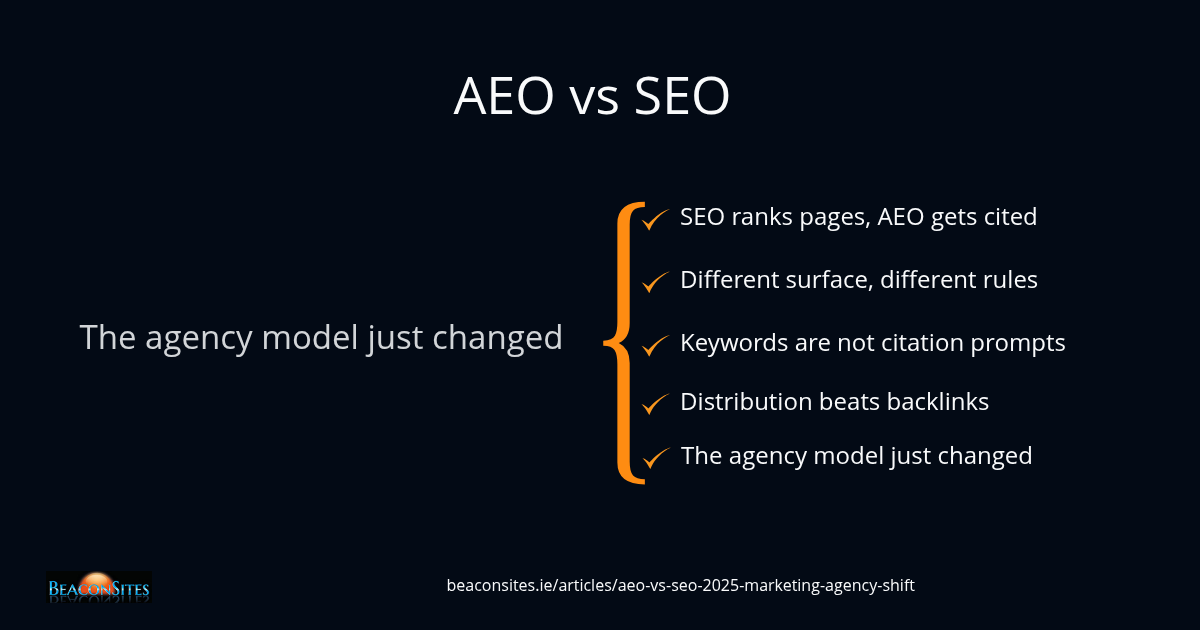
For twenty-five years, Search Engine Optimisation was the marketing discipline. Page rank, link building, keyword research, on-page signals, technical SEO. Every Irish SME with a website has heard the vocabulary. Most paid for at least some of the work.
That discipline did not disappear in 2025. It was relegated. A new discipline took the primary slot, driven by a hard change in customer behaviour: people stopped asking Google for recommendations and started asking AI engines instead.
The discipline they trusted to find businesses for them shifted from a ranking system to a citation system. Marketing agencies that recognised the shift early restructured around it. The agencies that did not are still selling the SEO playbook, sometimes with a new label on the front.
The replacement discipline is Answer Engine Optimisation, or AEO. It is not SEO with a chatbot bolted on. It is a different practice with different inputs, different metrics, and different outputs.
This article documents what actually changed in 2025, what AEO and SEO are doing differently in 2026, and what marketing buyers should be asking their agencies right now. For the broader thesis on why agencies are bifurcating in response, see The Quiet Race to Build Proprietary AI Content Infrastructure. For the precise definition of the metric AEO optimises for, see What Is Consensus Signal.
The two-year pivot that ended the SEO era
The shift did not happen on a single date. It happened across a measurable window, roughly Q1 2025 through Q4 2025, driven by two parallel trends that compounded.
The first was AI engine adoption among end users. ChatGPT crossed three hundred million weekly active users in late 2024 and continued accelerating through 2025. Perplexity, Claude, and Microsoft Copilot all reported step-change usage growth in the same window. By mid-2025, asking an AI engine for a vendor recommendation had moved from "what early adopters do" to "what everyone with a phone now does for any non-trivial purchase decision".
The second was Google's own integration of generative AI into its core search product. AI Overviews trigger on 48% of all US Google searches as of early 2026, up 58% year-on-year. Even users who stayed on Google were now consuming AI-synthesised answers instead of traditional ranked results for nearly half their queries.
The combination meant that by the end of 2025, a brand's visibility was being determined more by whether it appeared in AI-synthesised answers than by where it ranked on traditional search engine result pages. The discipline that had optimised for ranking became less load-bearing than the discipline that optimised for citation. SEO had not stopped working. It had stopped being primary.
SEO did not disappear in 2025. It was relegated. A new discipline took the primary slot, driven by a hard change in customer behaviour.
What SEO optimised for, and why it stopped being enough
Search Engine Optimisation was a discipline engineered around the Google ranking system. The work was concrete and measurable. Find a keyword someone searches.
Write a page that answers it. Earn inbound links to that page. Get the page to rank in the top ten of the search results.
Capture some percentage of the clicks from that ranking position.
Every input was anchored to a single page on a single site. Link authority pointed at pages. Keyword density was measured per page.
Meta tags described pages. The entire discipline assumed the user would see a list of pages, click one, and read it.
By 2025 that assumption was breaking. AI engines do not show users a list of pages. They show users an answer, synthesised from many pages, with the source pages referenced as citations rather than presented as the primary content.
A user asking "best Dublin marketing agency for SMEs" no longer sees ten links to compare. They see one answer that names two or three agencies, with citations.
SEO's reward structure was for the brand whose page won the click. AI search's reward structure is for the brand whose name appears in the answer. A page can rank without being cited.
A brand can be cited without any single page ranking. The decoupling broke a quarter-century of optimisation logic.
SEO optimises a page. AEO optimises an entity. SEO has been demoted to one component of the AEO toolkit.
What AEO optimises for instead
Answer Engine Optimisation is the discipline of engineering a brand's footprint across the open web so that AI engines cite the brand when synthesising answers in its category.
The unit of optimisation is the brand, not the page. AEO does not ask "is my page strong enough to rank". It asks "is my brand corroborated enough across independent sources to be confidently cited".
The inputs are different. AEO weights structured business data consistency (NAP across Google Business Profile, Apple Maps, Bing Places, industry directories), customer review platform presence (G2, Capterra, Trustpilot), third-party editorial mentions, schema and structured data on the brand's own site that matches third-party listings, and multi-format content syndication across channels AI engines retrieve from.
The metric is consensus signal: corroborated information about the brand across multiple independent sources that agree on the same facts. AI engines reward consensus signal with citation. Brands without consensus signal stay invisible regardless of how technically strong their own website is.
The proper way to think about AEO is that it sits one level above SEO. The on-page work SEO has always done is now part of the AEO toolkit, alongside the off-page footprint engineering. SEO did not disappear. It became a subset.
A page can rank without being cited. A brand can be cited without any single page ranking. The decoupling broke a quarter-century of optimisation logic.
Why the shift was forced, not chosen
Marketing agencies did not collectively decide that AEO was the future. The shift was forced by customer behaviour that moved faster than the industry adapted.
Three data points make the forcing function concrete. First, Pew Research found in July 2025 that when an AI summary appears in Google search results, only 8% of users click through to traditional search results, compared with roughly 15% when no AI summary is present. The click-through rate on traditional rankings nearly halved overnight on those queries. SEO investment that depended on capturing clicks from ranked positions lost half its value on the affected queries.
Second, an EMGI analysis of 150 SaaS companies found that 81% of brands recommended by ChatGPT did not appear in Google's top 10 results for the same query. The ranking system and the citation system had partially decoupled. A SaaS company could lose on Google and still win on ChatGPT, or vice versa. SEO investment alone no longer translated into AI search visibility, and AEO investment alone did not guarantee Google ranking.
Third, the Trustpilot and Seer Interactive study published in March 2026 quantified the off-page effect: brands with active profiles on at least two independent review platforms received 3.4 times the citation probability in ChatGPT compared with brands with none. The driver of citation was the brand's external footprint, not the strength of its own website.
Once these three findings stacked up across 2025, an agency selling pure SEO was effectively selling its clients an incomplete service. The choice was to add AEO or to lose the engagement to agencies that already had.
The shift was forced by customer behaviour that moved faster than the industry adapted. Agencies that recognised it restructured. Agencies that did not are selling the previous decade's playbook under new branding.
The agency response, in two opposing directions
Marketing agencies have responded to the shift in two directions, and the split is now structural rather than cyclical.
One direction is contraction. Large agencies cut content and marketing headcount, reasoning that AI tools could replace junior content production work. WPP launched the Elevate28 programme in 2026 targeting £500 million in annual cost savings through restructuring.
A Federal Reserve survey in Q1 2026 found that 74% of marketing and creative service firms that had adopted AI tools cut content or marketing headcount in the previous twelve months, by an average of 22%. The visible logic was that AI does the work, so fewer people are needed.
The other direction is reinvestment in proprietary infrastructure. Smaller agencies, often founder-led, recognised that AEO is not a workflow improvement on SEO. It is a different discipline that demands different infrastructure: in-house content pipelines that produce AEO-engineered articles at scale, multi-format transformation systems that turn one article into eight or ten outputs, and distribution networks that publish each format where AI engines retrieve from.
These agencies did not lay off. They re-tooled.
The two responses produce fundamentally different economics. Contracting agencies maintain billable rates while reducing labour cost. Reinvesting agencies absorb the cost of infrastructure and serve clients at price points that previously would have required twenty-person content teams. BeaconSites currently serves clients with AEO content production and syndication retainers starting at €999 per month, producing output volumes that traditional content marketing budgets at €5,000 to €10,000 per month historically could not match.
For marketing buyers, the practical implication is that the two responses produce different services. The cutter agencies are selling cheaper traditional marketing with AI-augmented production. The builder agencies are selling a different category of service entirely.
The right buyer question in 2026 is not "do you do AEO". It is "describe your NAP consistency process, your review platform recommendations, and your content distribution reach". Vague answers are SEO in disguise.
What this means if you are deciding between SEO and AEO right now
For an Irish SME or mid-market business making a marketing investment decision in 2026, the SEO-versus-AEO framing is the wrong question.
The right question is: are you optimising a page or are you optimising your entity. SEO done in isolation optimises a page. AEO done properly optimises the entity, and uses SEO techniques as one component of that work.
A useful test for an agency pitch in 2026 is to ask three concrete questions. First, what is your process for ensuring my NAP information is identical across Google Business Profile, Apple Maps, Bing Places, and the top three sector directories for my industry. An agency that cannot describe a process here is not doing AEO.
Second, which review platforms do you recommend my business build a presence on, and why those specifically. An agency that does not have a sector-specific recommendation is not doing AEO. Third, when you say you write content for me, what is the production process, and how many publishers does the content reach.
An agency that produces one blog post a month posted only to my own site is not doing AEO.
If the answers to those three questions are concrete and specific, the agency is doing real AEO work, and SEO is being done inside that work as a component. If the answers are vague, or the agency steers the conversation back to keyword research and on-page optimisation, what is being offered is 2018-era SEO with a new label.
The pivot from SEO to AEO is structural. The agencies that have made it are visibly different from the agencies that have not. The buyer's job is to tell them apart.
Data and evidence
| Data point | Value | Source |
|---|---|---|
| Google searches now triggering an AI Overview (US) | 48% (up 58% year-on-year through early 2026) | BrightEdge AI Overviews tracking report, May 2026 — https://www.brightedge.com/news/press-releases/one-year-google-ai-overviews-brightedge-data-reveals-google-search-usage |
| Click-through rate on traditional results when AI Overview appears | 8% (vs ~15% without) | Pew Research, July 2025 — https://www.pewresearch.org/short-reads/2025/07/22/google-users-are-less-likely-to-click-on-links-when-an-ai-summary-appears-in-the-results/ |
| ChatGPT-recommended brands NOT in Google's top 10 (SaaS analysis) | 81% (across 150 SaaS companies) | EMGI SaaS AI Citation Gap Report, 2026 — https://emgigroup.com/blog/saas-ai-citation-gap-report/ |
| Citation probability uplift — brands with profiles on 2+ review platforms | 3.4× vs brands with none | Seer Interactive / Trustpilot, March 2026 — https://www.seerinteractive.com/news/trustpilot-seer-study-how-review-profiles-impact-brand-ai-visibility |
| Marketing/creative service firms cutting content headcount after AI adoption | 74% (average 22% reduction) | Federal Reserve Q1 2026 survey — https://www.federalreserve.gov/econres/notes/feds-notes/monitoring-ai-adoption-in-the-u-s-economy-20260403.html |
| WPP Elevate28 annual cost savings target | £500 million by 2028 | AI Certs News, 2026 — https://www.aicerts.ai/news/marketing-agency-layoffs-surge-as-wpp-pursues-ai-efficiency-drive/ |
| ChatGPT weekly active users (late 2024 milestone) | 300 million | OpenAI public disclosures, late 2024 |
Terms used in this article
- Answer Engine Optimisation (AEO)
- The discipline of engineering a brand's footprint across the open web so that AI engines cite the brand when synthesising answers in its category. The unit of optimisation is the brand, not the page. AEO weights structured business data consistency, review platform presence, third-party editorial mentions, schema and structured data alignment across the brand's own site and third-party listings, and multi-format content syndication. The metric AEO optimises for is consensus signal: corroborated information about the brand across multiple independent sources.
- The 2025 Inflection Point
- The twelve-month window (Q1 2025 to Q4 2025) during which AEO replaced SEO as the primary marketing discipline. Triggered by two parallel forces: mainstream adoption of AI engines (ChatGPT crossed 300 million weekly users; Perplexity, Claude, and Microsoft Copilot saw step-change usage growth) and Google's integration of AI Overviews into a growing share of search results (reaching 48% trigger rate by early 2026). By the end of the window, brand visibility was determined more by AI citation than by traditional ranking position.
- Ranking-Citation Decoupling
- The observable phenomenon that Google ranking position and AI engine citation probability are now partially independent. Documented in the 2026 EMGI analysis of 150 SaaS companies, which found 81% of brands recommended by ChatGPT did not appear in Google's top 10 for the same query. The decoupling means SEO investment alone no longer translates into AI search visibility, and AEO investment alone does not guarantee Google ranking. The two systems require partly distinct optimisation strategies, with significant but incomplete overlap on technical elements like schema and structured data.
Common questions
What is the difference between SEO and AEO?
SEO (Search Engine Optimisation) is the discipline of getting pages to rank in traditional search results. AEO (Answer Engine Optimisation) is the discipline of getting brands cited in AI-synthesised answers. SEO's unit of optimisation is a single page on a single site.
AEO's unit is the brand entity across multiple sources. AEO uses SEO techniques as one component but extends to consensus signal engineering across review platforms, structured business data, third-party editorial, and multi-format content distribution.
Does this mean SEO is dead?
No. SEO is still functional for the half of queries where AI Overviews do not trigger and for users who click through to ranked results. But SEO done in isolation is no longer sufficient as a marketing strategy.
Most queries in 2026 either trigger an AI Overview or are issued directly to ChatGPT, Claude, Perplexity, or Microsoft Copilot. SEO work that does not also build the brand's AEO footprint leaves significant visibility on the table. The practical reframe is that SEO is now a subset of AEO, not a standalone discipline.
When did the AEO shift actually happen?
The shift took place between Q1 2025 and Q4 2025, driven by two parallel forces. AI engine adoption among end users moved from "early adopters" to "mainstream" as ChatGPT crossed 300 million weekly users and Perplexity, Claude, and Copilot saw step-change usage growth. At the same time, Google integrated AI Overviews into a growing share of search results, reaching 48% trigger rate by early 2026. By the end of 2025, brand visibility was being determined more by AI citation than by traditional ranking position.
Can I do AEO without doing SEO first?
For most businesses, yes — but it depends on what AEO work you start with. The three-surface AEO foundation (NAP consistency across business data platforms, review platform presence, structured data on your own site) does not require existing SEO investment. Once that foundation is in place, content production and syndication multiply the effect.
SEO techniques become useful for on-page elements (schema, FAQ structure, internal linking) but are no longer the entry point. Most SMEs starting AEO work in 2026 do not need to do conventional SEO first.
How can I tell if my current agency is still doing 2018-era SEO with a new label?
Three questions reveal it. Ask what process the agency uses to keep your NAP information identical across Google Business Profile, Apple Maps, Bing Places, and your sector directories. Ask which review platforms they recommend for your specific industry and why.
Ask how many publishers their content reaches each month. Real AEO agencies answer in concrete operational detail. SEO-with-new-branding agencies steer back to keyword research, page optimisation, or generic content marketing.
If the conversation cannot move beyond the brand's own website, the agency is not doing AEO.
Is there overlap between SEO and AEO?
Yes, significant overlap on technical elements. Schema markup, FAQPage structure, internal linking, and on-page content clarity all matter for both disciplines — AI engines extract from the same structural cues that Google ranks for. The difference is what work sits above and around those technical elements.
SEO stops at the page boundary. AEO continues outward to review platforms, third-party listings, content syndication, and the brand's full external footprint. A practical way to think about it: the schema you ship is shared infrastructure for both disciplines; everything else above and around it is distinct.
The pivot from SEO to AEO is the most consequential shift in digital marketing since search ranking itself emerged in the late 1990s. It happened quietly, across a single year, driven by customer behaviour rather than industry initiative. The agencies that recognised the shift restructured around it. The agencies that did not are still selling the previous discipline under new branding.
For Irish SMEs and mid-market businesses, the practical implication is concrete. The marketing work that mattered in 2020 is now a small component of the work that matters in 2026. The brand's external footprint — NAP consistency, review platform presence, structured data alignment, content syndication reach — is now the load-bearing investment. The single-page optimisation work that defined SEO has been demoted to a supporting role.
If you want to know exactly where your business currently stands across the five AI engines and the AEO surfaces that drive citation, the AI Visibility Audit tests your current footprint against ChatGPT, Claude, Perplexity, Google AI Overviews, and Microsoft Copilot. If you have already concluded that AEO is the discipline you need to invest in and you want it engineered at scale, the AEO Content Creation & Syndication service is the operational answer.