
What Is an AEO Agency? A 2026 Guide for Irish SME Owners
An AEO agency optimises content and entity signals so AI systems like ChatGPT and Google AI Overviews cite a business by name. With zero-click searches at 68% and AI Overviews growing fast, Irish SMEs should vet agencies on citation proof, platform coverage across all 7 engines, and methodology.
 By Lee Graham · Published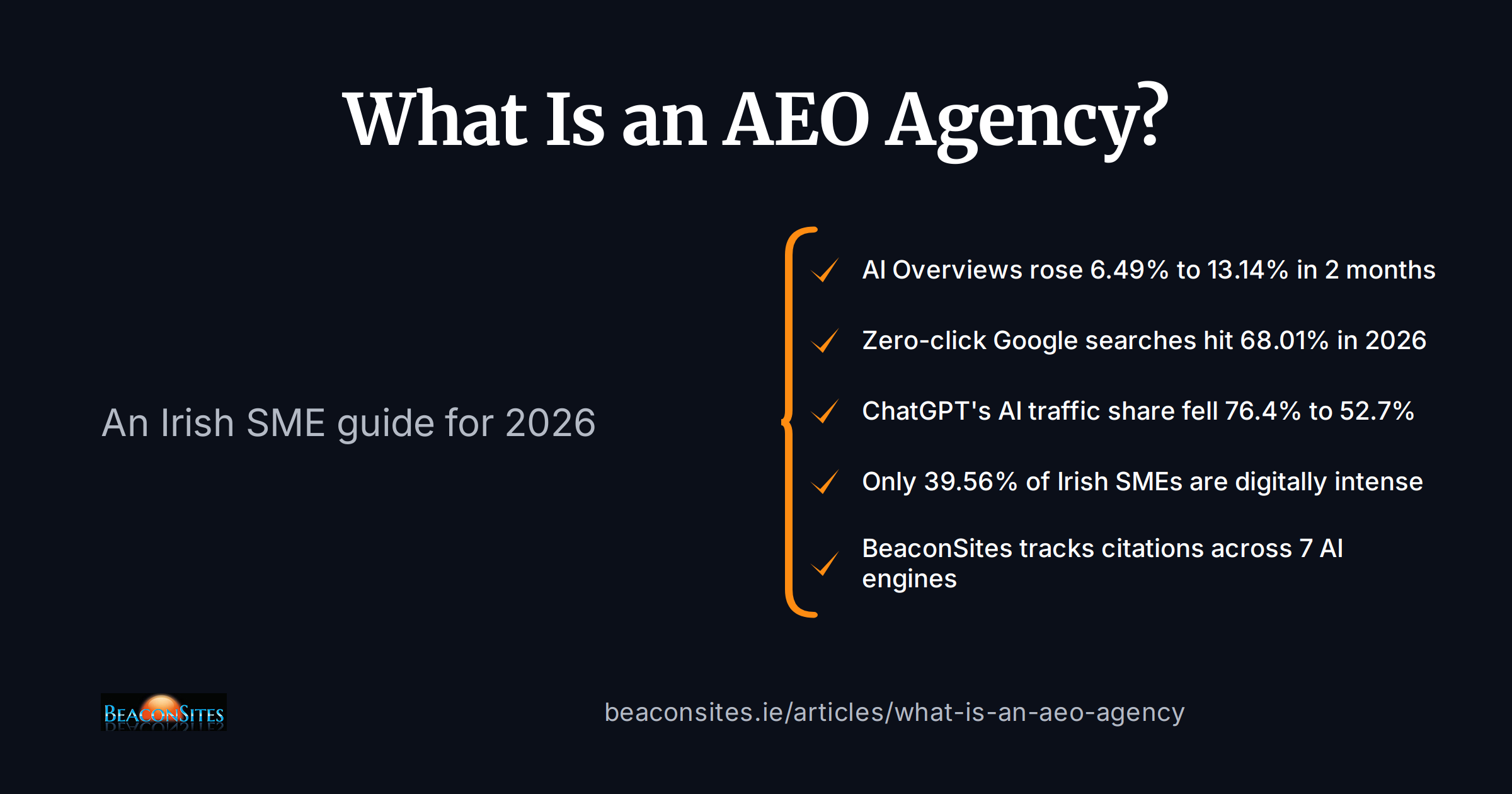
Answer Engine Optimisation (AEO) is the discipline of earning citation inside AI-generated answers — from ChatGPT, Perplexity, Claude, Microsoft Copilot, Google Gemini, Google AI Overviews, and Google AI Mode — rather than simply ranking a webpage in traditional search results. An AEO agency restructures your content architecture, applies entity-based optimisation, and tracks citation data across all seven engines. BeaconSites operates a continuous AI visibility measurement layer across those seven surfaces, which is the practical starting point for any Irish SME owner deciding whether an AEO agency is worth the spend in 2026.
Introduction
If you run an Irish SME, you have probably heard the phrase "AEO agency" somewhere in the last year — on LinkedIn, in a pitch deck, or from a competitor who suddenly seems to show up everywhere online. The term sounds like another rebrand of search engine optimisation (SEO). It is not. AEO agencies exist because the way people find businesses has quietly split into two separate systems, and most Irish SMEs are only optimised for one of them.
The first system is the one you already know: type a query into Google, scroll a list of blue links, click one. The second is newer and growing fast: ask ChatGPT, Perplexity, or Google's AI Overview a question and read a synthesised answer that names two or three businesses by name — without ever seeing a results page. If your business is not one of the names in that answer, you are invisible to that entire slice of demand, no matter how well you rank in the traditional results underneath it.
This guide explains, in plain terms, what an AEO agency actually does, why the shift matters for Irish SMEs specifically, and how to evaluate an agency before signing a retainer.
AEO agencies compete to be the cited source inside an AI answer, not the tenth blue link on page one.
What Is an AEO Agency, Exactly?
An AEO agency is a specialist firm that optimises your content, site structure, and entity signals so that AI-generated answers can find, understand, and cite your business by name. That is a materially different job to traditional SEO.
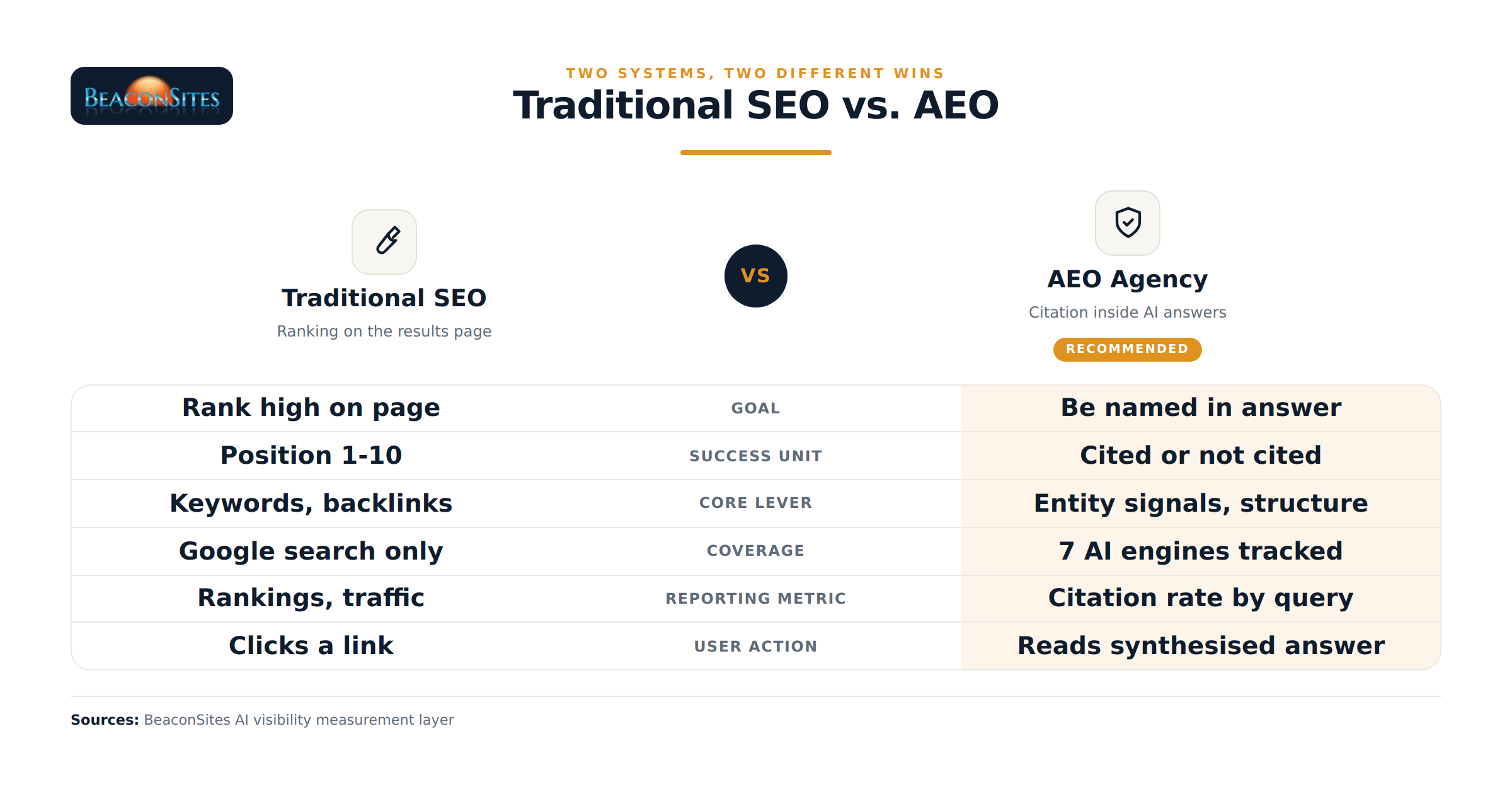
Traditional SEO competes for position on a results page: you optimise for keywords, backlinks, and technical performance so your link shows up as high as possible, and the user decides whether to click.
AEO competes to be one of the two-to-five sources an AI system chooses to cite when it writes a direct answer. There is no "position 3" in an AI answer — either your business is named, or it is not.
A credible AEO agency typically runs five core workstreams:
- AI visibility audits — testing your current citation rate across ChatGPT, Perplexity, Claude, Copilot, Gemini, Google AI Overviews, and Google AI Mode for the specific questions your buyers actually ask. Claude citation tracking is run on request as part of a paid AI Visibility Audit rather than as standard ongoing coverage, because it is materially more expensive to measure.
- Content architecture — restructuring pages so AI systems can extract a clean, direct answer: clear heading hierarchy, answer-first paragraphs, and content built around real questions rather than keyword phrases.
- Entity-based optimisation — making your business a recognised, consistent "entity" across the web: matching business details, clear author credentials, and topical authority in a specific niche rather than generic breadth.
- Structured data — Google's own guidance for AI features is candid that structured data is not a strict requirement for AI Overviews or AI Mode, but the same standard markup and people-first content that already earns organic visibility also feeds those AI features, reducing ambiguity about what a page is actually about.
- Citation tracking and reporting — measuring how often, and for which queries, your business is actually named inside an AI-generated answer, since that is the only metric that proves AEO is working.
Most AEO agencies stop at those five. BeaconSites adds a sixth: every build ships with at least one expert-quality article produced in eight formats and syndicated across 300+ high-traffic sites, including many with high domain authority.
The point is not the logos. It is that AI engines see the same claims about a business repeated across many independent sources from the day it launches — and that repetition is the consensus signal those systems weigh when deciding whom to cite. One page claiming expertise is an assertion. The same material carried by hundreds of independent sources is a pattern.
The practical difference for a business owner is this: an SEO report shows you rankings and organic traffic. An AEO report shows you which AI answers now name your business — and which competitors are still being cited instead.
BeaconSites treats ChatGPT, Perplexity, Claude, Copilot, Gemini, AI Overviews, and AI Mode as one visibility surface.
Why This Matters for Irish SMEs in 2026
The traffic pattern has already shifted
OpenAI reported that ChatGPT reached 900 million weekly active users in February 2026, more than double its user base a year earlier. That volume alone would matter little if people were still clicking through to websites afterwards — but they largely are not. Independent research firm SparkToro found that Google searches in the US ended without any click 68.01% of the time during the first four months of 2026.
Zero-click search is not a future risk. It is the current default.
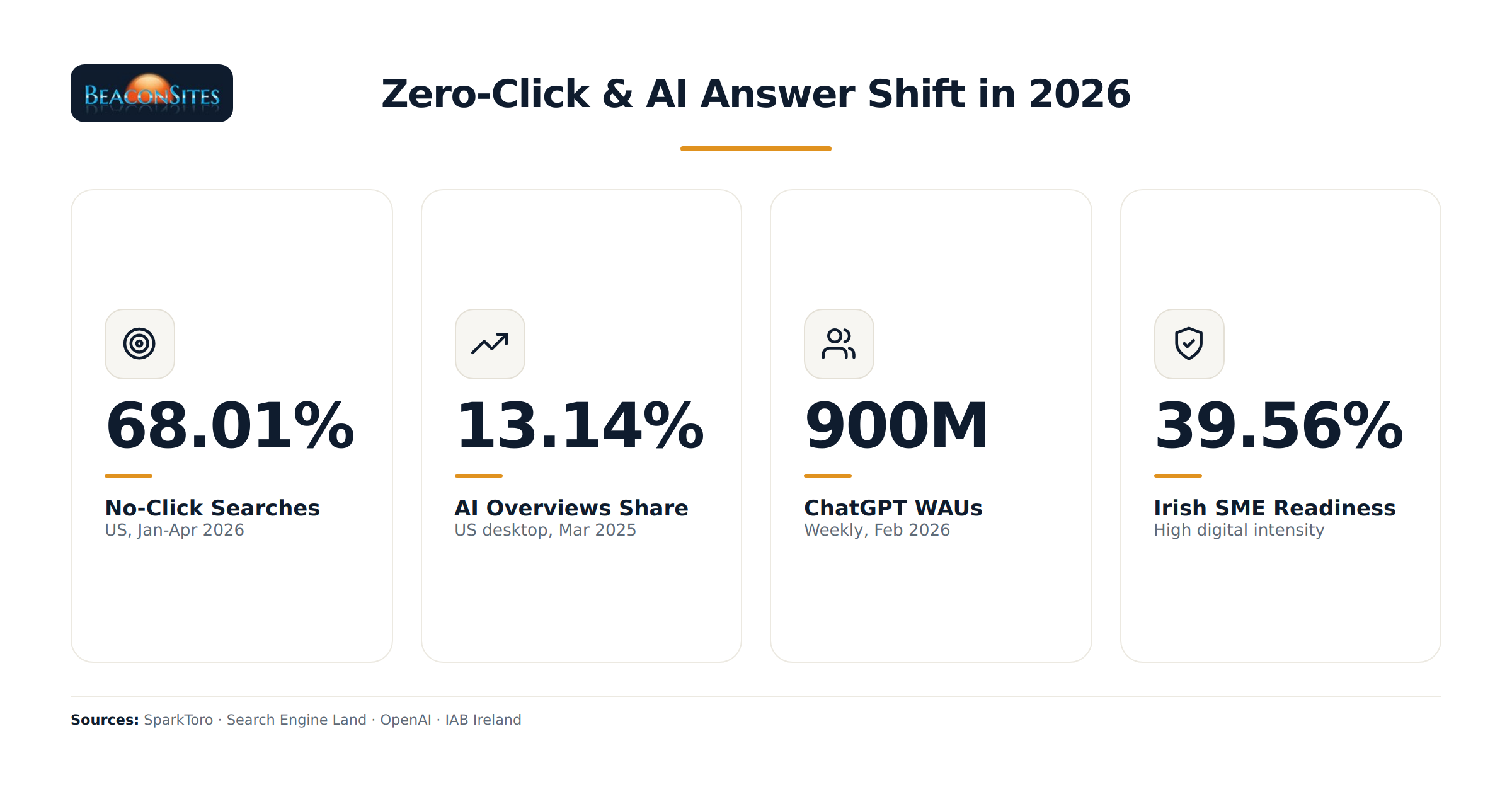
At the same time, Google's own AI Overviews expanded rapidly on the traditional results page itself: appearing in 13.14% of all US desktop searches by March 2025, up from 6.49% just two months earlier, according to industry research published by Search Engine Land. An AI-written summary now frequently sits above the organic results your SEO agency has spent years optimising for.
No single AI engine owns this space
A further complication for Irish SMEs: the AI answer landscape is not settling around one dominant player. Similarweb's clickstream data shows ChatGPT's share of generative AI website visits falling from 76.4% in June 2025 to 52.7% by May 2026, while Google Gemini's share rose from 8.9% to 27.3% and Claude's rose from 1.6% to 8.9% over the same period. An AEO agency that only tracks ChatGPT citations is already missing roughly half the relevant traffic — which is exactly why BeaconSites measures citation frequency across all seven engines rather than optimising for whichever one happens to be fashionable this quarter.
Irish SMEs are under-prepared
Ireland's own digital advertising market grew to €1.146 billion in 2025, an 8% year-on-year increase, according to IAB Ireland — with social media adspend alone climbing 12% to €576 million. Spend is rising. Readiness is not keeping pace: Ireland's 2025 Digital Decade country report found that only 39.56% of Irish SMEs had reached a high or very high level of digital intensity, ahead of the EU average of 32.66%, but still leaving the majority of Irish SMEs in the low-to-basic band. That gap is precisely the opening an early AEO adopter can use to establish category authority before competitors catch up.
If an agency can't show a citation-tracking dashboard, they're selling SEO with an AEO label glued on.
How to Evaluate and Choose an AEO Agency
Warning sign: "We do SEO and AEO"
If an agency describes AEO as an add-on line item to their existing SEO service, with no distinct methodology, treat that as a warning sign. AEO requires different measurement (citation rate, not ranking position), different content structuring (answer-first architecture, not keyword density), and different platform knowledge (seven distinct AI engines with different citation preferences).
Criterion 1: Platform coverage, stated explicitly
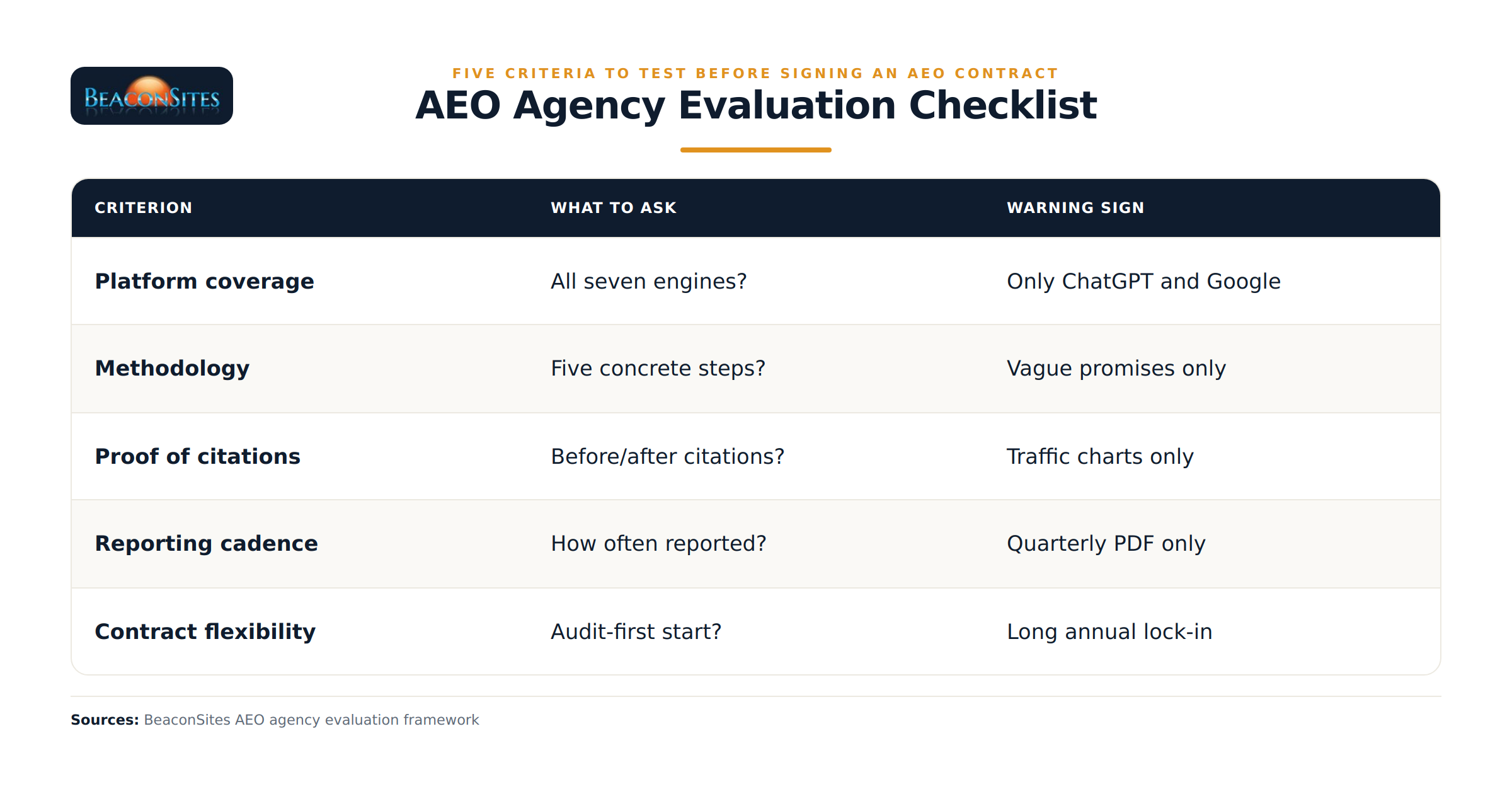
Ask which platforms the agency actually tracks. A credible answer names all seven current engines — ChatGPT, Perplexity, Claude, Microsoft Copilot, Google Gemini, Google AI Overviews, and Google AI Mode — not just "ChatGPT and Google." Given how quickly citation share moves between engines, an agency fixated on one platform is optimising for yesterday's traffic pattern.
Criterion 2: A documented, repeatable methodology
A genuine AEO process should be describable in five concrete steps: baseline audit, content architecture review, entity optimisation, implementation, and ongoing citation measurement. If the answer is vague — "we'll improve your visibility" — with no specific plan, that is a warning sign.
Criterion 3: Proof of citations, not just traffic
This is the single most important test. Ask the agency to show you a before-and-after example of an actual AI-generated answer that now names one of their clients. Traffic charts and ranking improvements are SEO metrics dressed up as AEO results. Citation evidence is the only proof that matters.
Criterion 4: Team structure and specialisation
AEO work spans technical structured-data implementation, answer-first content writing, and citation measurement. One generalist account manager juggling all three, with no named specialists, is a warning sign for a service this new and this technical.
Criterion 5: Contract flexibility
Because AEO measurement itself is still maturing, favour agencies offering shorter initial engagements — a defined audit followed by a review point — over agencies pushing straight into long, rigid annual contracts before you have seen any citation data at all.
SparkToro's own data puts zero-click Google searches above two-thirds in the US right now.
AEO vs SEO: Do You Need Both?
Yes — but the honest answer is that they are complementary, not competing, investments. Zero-click behaviour and AI Overviews sit on top of the same organic search index that SEO has always optimised for; Google's own guidance confirms that people-first content and standard structured data feed both experiences. Dropping SEO entirely to chase AEO would mean losing the foundation that AI systems are still partly drawing from.
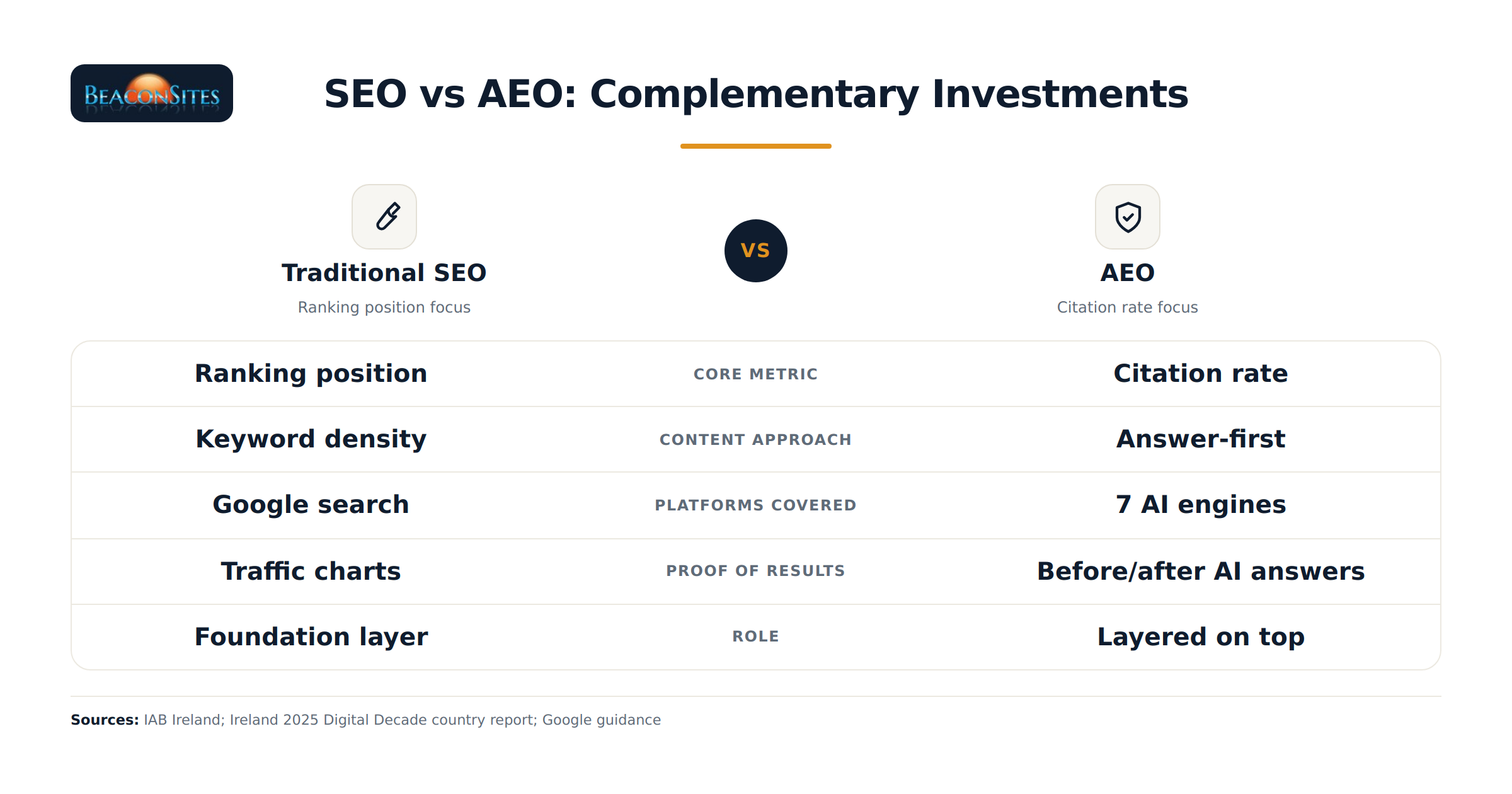
The practical guidance for most Irish SMEs: maintain existing SEO investment, layer AEO on top rather than replacing anything, and use citation tracking (not ranking position) as the metric that tells you where the incremental budget should go next.
BeaconSites runs a €299 AI Visibility Audit so owners see the gap before spending on a retainer.
Where BeaconSites Fits
BeaconSites was built specifically for this shift, positioned as an AI-native AEO specialist rather than a traditional SEO firm that has bolted "AI" onto its service list. BeaconSites offers a €299 AI Visibility Audit as the practical entry point: a structured review of exactly where your business currently stands — and where it is absent — across ChatGPT, Perplexity, Claude, Copilot, Gemini, Google AI Overviews, and Google AI Mode, paired with a 30-minute consultation to walk through the findings.
For businesses that want ongoing citation building rather than a single point-in-time audit, BeaconSites runs a monthly AI visibility programme from €999/month, covering content architecture, entity optimisation, and continuous citation tracking across all seven engines. The audit is deliberately the low-friction first step; the subscription conversation happens only once you have seen your own citation data, not before.
Data and evidence
| Data point | Value | Source |
|---|---|---|
| Google AI Overviews share of US desktop searches | 13.14% in March 2025, up from 6.49% in January 2025 | Search Engine Land industry research, March 2025 |
| Zero-click Google searches in the US | 68.01% of searches ended without a click, early 2026 | SparkToro (Rand Fishkin) research, 2026 |
| ChatGPT weekly active users | 900 million as of February 2026, up from ~400 million a year earlier | OpenAI, "Scaling AI for Everyone," February 2026 |
| ChatGPT share of generative AI website visits | Fell from 76.4% (June 2025) to 52.7% (May 2026); Gemini rose 8.9%→27.3%, Claude 1.6%→8.9% | Similarweb research, 2026 |
| Irish digital advertising spend | €1.146 billion in 2025, up 8% year-on-year; social adspend €576m, up 12% | IAB Ireland, 2025 adspend report |
| Irish SME digital intensity | Only 39.56% reached high/very high digital intensity vs EU average 32.66% | Ireland 2025 Digital Decade country report (European Commission / enterprise.gov.ie) |
| E-E-A-T framework definition | Experience, Expertise, Authoritativeness, Trustworthiness | Google Search Central documentation, developers.google.com |
| Structured data's role in AI features | Not strictly required for AI Overviews/AI Mode, but shares the same content foundation as organic Search | Google Search Central, AI optimisation guide |
Terms used in this article
- Answer Engine Optimisation (AEO)
- The practice of structuring content, entity signals, and technical markup so AI systems can extract and cite a business by name within a generated answer, rather than simply linking to it in a results list.
- Entity-based optimisation
- Building a business into a consistently recognised 'entity' across the web through matching business details, credentialed authorship, and concentrated topical authority, so AI systems can confidently attribute claims to it.
- AI visibility audit
- A structured review measuring how often, and for which queries, a business is currently cited across major AI engines, used to set a measurable baseline before any optimisation work begins.
Common questions
How much does an AEO agency cost for an Irish SME?
Pricing varies widely by scope. BeaconSites structures its offer in two stages: a €299 AI Visibility Audit with a 30-minute consultation as the entry point, then an ongoing AI visibility programme from €1,000 per month for businesses that want continuous content architecture work and citation tracking across all seven major AI engines. Always confirm exactly what a monthly retainer covers before signing.
How is AEO different from traditional SEO for an Irish business?
SEO competes for ranking position on a results page and is measured by clicks and traffic. AEO competes to be one of the few sources an AI system actually names when it writes a direct answer, and is measured by citation frequency across engines like ChatGPT, Perplexity, and Google AI Overviews. They use different content structures, different tools, and different success metrics entirely.
How long does it take to see citations in AI-generated answers?
Timelines vary by niche, competition, and how much rebuilding your existing content needs. Because citation share shifts between AI engines fairly quickly — as seen with Gemini and Claude gaining ground on ChatGPT through 2025 and 2026 — most agencies recommend starting with an audit to set a measurable baseline, then reviewing citation movement on a monthly cadence rather than expecting instant results.
Which AI platforms should an AEO agency actually track?
A credible agency tracks all seven current major engines: ChatGPT, Perplexity, Claude, Microsoft Copilot, Google Gemini, Google AI Overviews, and Google AI Mode. Citation share moves between these platforms substantially from year to year, so an agency focused on only one or two engines is measuring an incomplete and increasingly outdated picture of your AI visibility.
Do I still need SEO if I invest in AEO?
Yes. Google's own guidance confirms that the structured data and people-first content supporting organic Search also feed AI Overviews and AI Mode, so the two disciplines share a foundation. Most Irish SMEs should maintain existing SEO work and layer AEO on top, rather than treating one as a replacement for the other.
AEO agencies exist because AI-generated answers now sit ahead of — and sometimes entirely instead of — the traditional results page your existing SEO work targets. For an Irish SME, the decision is not whether AI search is real; the data above already answers that. The decision is whether to find out where your business currently stands before a competitor does.
BeaconSites publishes citation data across all seven major AI engines so Irish SME owners can make that call with evidence rather than guesswork. The most direct way to get that evidence is a €299 AI Visibility Audit and a short consultation to walk through exactly what it shows.