
Why AI Engines Cite Third-Party Sources Over Your Own Website
AI engines cite third-party sources in 84 to 89% of generated answers. MuckRack's 2026 analysis of 25 million links confirms the pattern across ChatGPT, Claude, and Google AI. The implication for Irish brands is that owned content alone rarely produces AI citation. Earning third-party coverage through structured content distribution is the new ranking-equivalent investment.
 By Lee Graham · Published · Updated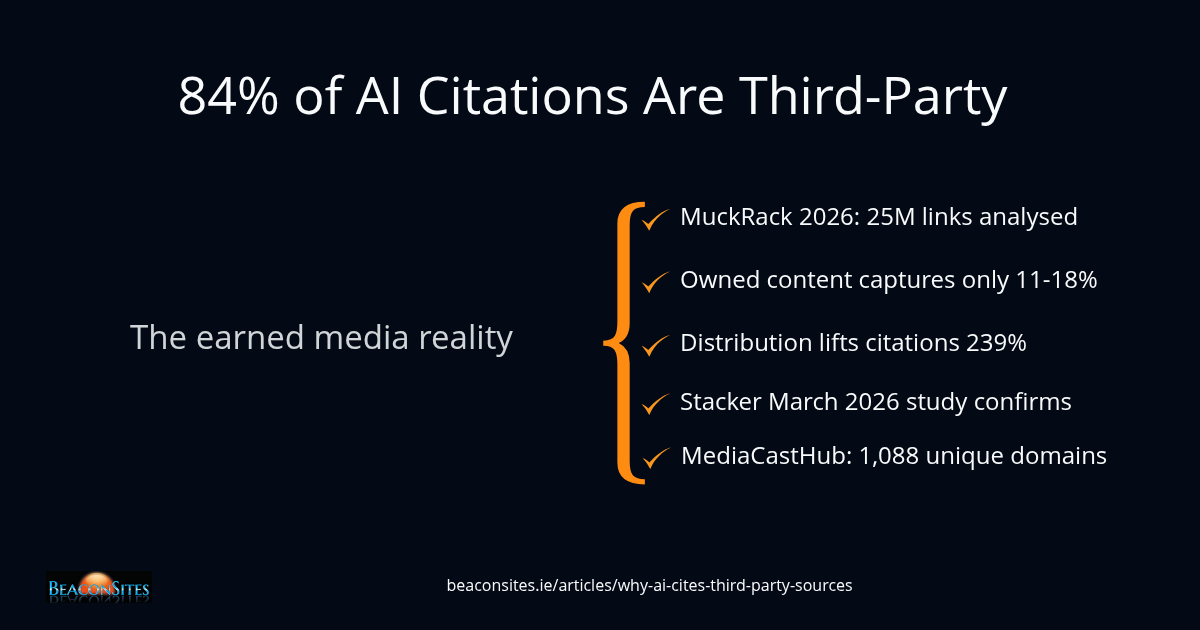
AI engines cite third-party sources in 84 to 89 per cent of generated answers. A 2026 MuckRack analysis of 25 million links across ChatGPT, Claude, and Google AI found earned media — independent editorial coverage in third-party publications — accounted for 84 per cent of all AI citations. A separate 5WPR study put the figure at 85.5 per cent.
AuthorityTech's synthesis of the broader research landscape placed it at 89 per cent. The range varies; the pattern does not.
For Irish brands, the implication is structural. A business that publishes only on its own domain is competing for the 11 to 18 per cent of AI citations that come from owned content. The 82 to 89 per cent of citations on the other side of the equation are earned across third-party publishers — and those citations are not allocated by ranking algorithms but by editorial coverage, syndication footprint, and review-platform presence.
This article explains the research, why AI engines weight third-party sources so heavily, and the practical playbook Irish SMEs can use to earn them. For the broader thesis on how AI citation now drives commercial discovery, see The Quiet Race to Build Proprietary AI Content Infrastructure. For the underlying metric, see What Is Consensus Signal.
What the research actually shows: 84 per cent of AI citations are third-party
The clearest available data on AI citation behaviour comes from MuckRack's Generative Pulse analysis, published in May 2026. MuckRack analysed 25 million links cited by ChatGPT, Claude, and Google AI across a sample of generated answers. Earned media — independent editorial coverage in third-party publications — accounted for 84 per cent of all citations.
The finding has been corroborated independently. 5WPR's parallel study placed the figure at 85.5 per cent. AuthorityTech's synthesis of the broader research landscape put it at 89 per cent — the figure most commonly quoted in industry discussion. Fullintel's academic study reported the share exceeded 89 per cent for cited links and 95 per cent when including all non-paid sources.
The methodologies differ. MuckRack analysed links cited as sources in AI responses. 5WPR weighted by visibility.
AuthorityTech synthesised across multiple primary studies. The range across studies is 82 to 95 per cent. Within that range, the pattern is consistent across every major engine and study design: earned media dominates AI citation graphs.
For brands, the practical reading is that owned content — a business's own website, blog, and social channels — accounts for the remaining 11 to 18 per cent of AI citations. A brand investing only in owned content is competing for the smaller share, not the larger one. The Yext counter-finding sometimes raised in industry discussion (which reports 86 per cent of AI citations come from brand-managed sources) reconciles when "brand-managed" is read to include third-party listings like Google Business Profile and Trustpilot rather than the brand's own domain only. Both findings can be true; they describe different slices of the same citation graph.
AI engines cite third-party sources in 84 to 89 per cent of generated answers. A business that publishes only on its own domain is competing for the smaller 11 to 18 per cent share.
Why AI engines weight earned media so heavily
The reason is structural, not editorial. AI engines synthesise answers by aggregating information across many sources during generation, weighting facts by how consistently those sources agree. The mechanism is called cross-source corroboration, and it is the operational backbone of how ChatGPT, Claude, Perplexity, Google AI Overviews, and Microsoft Copilot decide which brands to cite.
A brand mentioned in one source provides one data point. The AI engine has nothing to verify it against. A brand mentioned consistently across many independent sources provides many corroborating data points.
The AI engine can confirm the brand exists, what it does, where it operates, and what its reputation looks like, by comparing sources against one another. Higher corroboration produces higher confidence and higher citation probability.
Earned media in third-party publications is the highest-weighted category because it is the hardest to fabricate. A brand can publish whatever it wants on its own website. Independent editorial coverage requires a journalist, a publication, or an aggregator to find the brand newsworthy. AI engines treat that filter as a credibility signal.
This is also why paid placements are weighted lowest. AI engines can detect advertorial content, sponsored placements, and obvious press-release-only sources — and they discount them accordingly. Across the studies surveyed, paid content represents less than 0.5 per cent of AI citations.
The citation graph rewards earned coverage and penalises paid coverage. This is the inverse of the dynamic SEO trained marketers to expect.
When the same article is distributed across third-party publishers, AI citation rates rise from 7.6 per cent to 34 per cent — a 4.4× lift documented in controlled study conditions.
Three categories of third-party source — and which AI engines weight highest
The phrase "third-party source" covers three distinct categories with different weighting in AI citation graphs. Resolving the distinction is the difference between an effective AEO strategy and a wasted budget.
| Category | What it is | Citation weight | Examples |
|---|---|---|---|
| Editorial third-party | Independent journalism and editorial coverage | Highest | News articles, industry publications, podcasts, expert roundups, comparative reviews, syndicated press |
| Brand-managed third-party | Listings on independent platforms where the brand controls the data but the platform is external | Middle | Google Business Profile, Trustpilot profile, G2 listing, Apple Maps, Bing Places |
| Owned content | The brand's own website, blog, social channels, and email | Lowest (except for original research) | Brand homepage, blog posts, product pages, LinkedIn posts |
The practical takeaway is that an AEO strategy needs to invest across all three categories with weighting that matches their citation share. Most marketing budgets are heavily concentrated in owned content, which captures the smallest share of citations. Reallocating investment toward editorial third-party (via structured content distribution) and brand-managed third-party (via review-platform presence) produces measurably better citation outcomes per pound of budget.
The Trustpilot and Seer Interactive joint study from March 2026 quantifies the review-platform side of the equation: brands with active profiles on at least two independent review platforms are cited by ChatGPT 3.4 times more often than brands with none. Even one platform produces a 3x lift. That uplift comes from the brand-managed third-party category, and it is achievable in days rather than months.
A brand that exists only on its own domain, without third-party coverage in publishers AI engines treat as authoritative, is not a resolved entity in the citation graph.
The distribution lift — how third-party citations are actually earned
If 84 to 89 per cent of AI citations come from third-party sources, the operational question is how a brand earns them at scale. The controlled study evidence on this point is striking.
Stacker's March 2026 study compared AI citation rates for the same article in two conditions: published only on the brand's own domain, and distributed across third-party publisher networks. The distributed version achieved a 239 per cent median lift in AI citations across ChatGPT, Claude, and Google AI. An earlier Stacker pilot in December 2025 reported an even stronger effect: citation rates rose from 7.6 per cent baseline to approximately 34 per cent after distribution, a 325 per cent lift.
The mechanism is direct. Distribution multiplies the corroboration footprint. A single source article published on one domain provides one citation surface. The same article syndicated across 800 to 1,100 unique publisher domains provides hundreds of corroborating surfaces, each one another data point AI engines weight when deciding whom to cite.
BeaconSites' own distribution data illustrates the operational pattern. A single BeaconSites source article distributed via the MediaCastHub infrastructure yielded 1,566 syndicated placements across 800+ unique publisher domains. Average Domain Authority across placements was 41.9, with 27 placements on DA-80+ properties including AP News, Markets Business Insider, Flipboard, Calameo, and Barchart. This is what the third-party citation surface looks like in practice — not a single placement, but an entire corroboration footprint engineered to satisfy the cross-source weighting AI engines apply.
Distributed citations also persist longer. Stacker's source decay research found distributed content maintained AI citation authority for approximately 10 weeks before decay, compared to 4.5 weeks for brand-only content. The 2.1x persistence advantage is significant because it means a sustained distribution cadence keeps the citation surface alive without the brand needing to re-publish constantly. A brand running a monthly distribution rhythm sustains a continuous citation footprint.
Distributed content maintains AI citation authority for 2.1× longer than brand-only content — roughly 10 weeks versus 4.5 weeks before decay.
The exception — when your own domain does win AI citations
The 84 to 89 per cent earned media figure has one significant exception. Owned-domain content publishing original research, proprietary data, or analysis unavailable elsewhere achieves citation rates of 38 to 65 per cent across major AI engines. This is the only owned-content category that consistently beats earned media on every engine surveyed.
The mechanism is uniqueness. AI engines have to cite the original source when no third-party publisher has the same data. A brand that publishes its own customer survey, its own platform metrics, its own benchmark study, or its own analytical work becomes the only available citation surface for that data. Third-party publishers may reference and link to the data, but the original brand domain remains the primary citation target.
The BeaconSites distribution metrics published openly on this site (1,566 placements, 800+ unique publisher domains, Domain Authority 41.9 average) are an example of this pattern operating in practice. The numbers are proprietary — no other source has them — so AI engines asked questions about MediaCastHub distribution reach cite BeaconSites directly rather than referencing third-party coverage.
The practical implication for Irish SMEs is to publish what only you can publish. Internal benchmarks, anonymised case data, customer survey results, proprietary methodologies, original analytical work — these are the owned-domain content categories that earn AI citation. The mistake is publishing the same generic industry commentary every other blog publishes; AI engines will cite the higher-authority third-party source instead. The opportunity is publishing what no one else has.
Original research and proprietary data are the one owned-content category that beats earned media on every AI engine. Brands that publish data competitors cannot replicate accumulate citation probability that compounds.
What Irish brands should do about the third-party citation gap
The data describes the new operating reality. The practical question is how Irish brands respond to it without rebuilding their entire marketing operation. The answer is a sequenced four-step playbook.
Step one — audit current AI citation rate. Most brands do not know whether they are being cited by ChatGPT, Claude, Perplexity, Google AI Overviews, or Microsoft Copilot today. An AI Visibility Audit benchmarks current citation rate on a defined set of buyer prompts in the brand's category, with a side-by-side comparison against competitors. Without this baseline, every subsequent investment is unmeasured. The audit is one-off and pays for itself once it identifies the highest-leverage gaps.
Step two — fix the review-platform footprint. This is the fastest brand-managed third-party investment available. A Trustpilot profile with active review collection produces a 3x AI citation lift compared to no profile, and 3.4x when paired with a profile on G2 or a sector-equivalent. The technical work is minimal; the credibility-signal work (collecting actual customer reviews) is the longer build. Brands that have not started this yet are leaving the highest single citation lever on the table.
Step three — invest in structured source content with built-in distribution. This is the editorial third-party investment. Source content engineered for extraction (FAQ schema, definition-first paragraphs, named-entity reinforcement) is distributed across hundreds of independent publisher domains using a syndication infrastructure like MediaCastHub. A single source article becomes the cross-source corroboration footprint AI engines weight. The investment is sustained — monthly cadence works better than one-off — but the per-article ROI improves over time as the cumulative citation surface compounds.
Step four — publish what only you can publish. Identify the proprietary data, internal benchmarks, customer survey results, or original analytical work no third-party publisher has. Publish it on your own domain in structured form. This is the owned-content exception that wins AI citation on uniqueness rather than corroboration. For most brands, this is a 90-day project, not an ongoing investment — but the citation surface it creates persists for years.
Brands working through all four steps in 2026 are accumulating citation probability that compounds beyond the reach of late entrants. Brands working on only one or two are partially exposed. Brands working on none are invisible in the citation graph regardless of how strong their owned content is.
Data and evidence
| Data point | Value | Source |
|---|---|---|
| Earned media share of AI citations (across ChatGPT, Claude, Google AI) | 84% | MuckRack Generative Pulse, May 2026 (25 million links analysed) — https://muckrack.com/ |
| Earned media share — corroborating study | 85.5% | 5WPR AI citation analysis, 2026 |
| Earned media share — broader synthesis | 89% | AuthorityTech synthesis of available evidence, 2026 — https://authoritytech.io/blog/the-citation-economy-earned-media-ai-visibility |
| AI citation lift from third-party distribution (median) | 239% | Stacker AI citation controlled study, March 2026 |
| AI citation rate without distribution vs with distribution | 7.6% to 34% (325% lift) | Stacker AI citation pilot, December 2025 |
| Citation persistence (distributed vs brand-only content) | 2.1x longer (10 weeks vs 4.5 weeks) | Stacker source decay research, 2026 |
| ChatGPT share of earned/news citations | 51.1% | Machine Relations Research, 2026 — https://machinerelations.ai/research/earned-vs-owned-ai-citation-rates-2026 |
| Claude share of earned/news citations | 43.1% | Machine Relations Research, 2026 — same source |
| Original research / proprietary data citation rate (owned-content exception) | 38-65% | Industry composite, 2026 |
| BeaconSites MediaCastHub verified placements per single source article | 800+ unique publisher domains (1,566 total placements) | BeaconSites / MediaCastHub verified distribution run, May-June 2026 |
Terms used in this article
- Earned Media (AI Citation Context)
- Independent editorial coverage of a brand in third-party publications that AI engines treat as authoritative. Includes news articles, industry publications, podcasts, expert roundups, comparative reviews, and syndicated content placements. Earned media is distinct from owned content (brand's own website), paid content (advertorials, sponsored placements), and brand-managed third-party listings (Google Business Profile, Trustpilot profile). Earned media accounts for 82 to 89 per cent of all AI citations across major engines.
- Cross-Source Corroboration
- The structural reason AI engines weight third-party sources so heavily. AI engines synthesise answers by aggregating information across many sources and weighting facts by how consistently those sources agree. A brand mentioned in one source provides one data point; the same brand mentioned consistently across hundreds of independent sources provides hundreds of corroborating data points. Higher corroboration produces higher citation probability.
- Content Distribution / Syndication
- The mechanism by which a single source article is republished across multiple independent publisher domains, generating earned third-party citations at scale. Distribution networks like MediaCastHub place structured source content across news syndication services, industry publications, and aggregator networks. A typical BeaconSites distribution run yields approximately 1,000 to 1,500 placements across 800 to 1,100 unique publisher domains from one source article.
- Source Extractability
- The structural quality that makes content easy for AI engines to lift verbatim into generated answers. Extractable content opens with direct answers in the first two sentences, uses summary tables and FAQ blocks with schema markup, and calls out named entities (people, products, places) explicitly rather than implying them. Source extractability and distribution work together — well-distributed but poorly structured content gets republished but not cited; well-structured but undistributed content gets cited once but not across the corroboration footprint AI engines weight.
Common questions
Why do AI engines cite third-party sources more than a brand's own website?
AI engines synthesise answers by aggregating facts across many sources and weighting them by cross-source agreement. A brand mentioned only on its own domain provides one data point; the same brand cited consistently across hundreds of independent publishers provides hundreds of corroborating points. Higher corroboration produces higher citation probability. The MuckRack 2026 analysis of 25 million AI citations found 84 per cent came from earned media in third-party publications, with the remaining 16 per cent split between owned content and brand-managed listings.
What percentage of AI citations come from third-party sources?
Research across major studies in 2025 and 2026 places the figure at 82 to 95 per cent. MuckRack's 25-million-link analysis found 84 per cent. 5WPR's study placed it at 85.5 per cent.
AuthorityTech's broader synthesis put it at 89 per cent. Fullintel's academic study exceeded 89 per cent. The methodology and scope differ between studies, but the pattern is consistent: earned media dominates AI citation graphs across ChatGPT, Claude, Google AI, and other major engines.
Does this mean my own website is useless for AI search?
No, but its role is more specific than most marketing teams treat it. Your website provides the structured source content that AI engines extract from and that third-party publishers syndicate. Original research, proprietary data, and structured FAQ blocks on your own domain do win AI citations — particularly when the data is not available elsewhere. The mistake is treating your website as the primary citation surface; it is the source content engine, with the citation surface itself spread across the publisher footprint your content reaches.
What counts as a third-party source for AI engines?
Three categories with different weighting. First, editorial third-party — news articles, industry publications, podcasts, expert roundups in publishers AI engines treat as authoritative. This is the highest-weighted category.
Second, brand-managed third-party — listings on Google Business Profile, Trustpilot, G2, Apple Maps, and similar platforms where the brand controls the listing but the platform is independent. This is the middle category. Third, owned content — the brand's own website and channels.
This is the lowest-weighted category in most AI citation graphs.
How do I earn third-party AI citations for my Irish business?
Three concurrent investments. First, structured source content on your own domain that AI engines and third-party publishers can extract cleanly. Second, distribution of that source content across independent publisher networks — services like MediaCastHub place a single source article on 800 to 1,100 unique publisher domains per run.
Third, review-platform presence on Trustpilot at minimum, plus G2 or sector-equivalents. The combination of all three produces the cross-source corroboration AI engines weight when deciding whom to cite.
How long until distributed third-party content stops earning AI citations?
Distributed third-party content maintains AI citation authority for approximately 10 weeks on average, compared to 4.5 weeks for brand-only content, according to Stacker's 2026 source decay research. This 2.1× persistence advantage is significant because it means a sustained distribution cadence keeps the citation surface alive without the brand needing to re-publish constantly. A brand running a monthly distribution rhythm sustains a continuous citation footprint.
Is there any owned content that does win AI citations?
Yes — original research and proprietary data. Owned-domain content publishing data that does not exist elsewhere achieves a 38 to 65 per cent citation rate across major AI engines, the only owned-content category that consistently beats earned media. The mechanism is uniqueness: AI engines have to cite the original source because no third-party publisher has the same data.
BeaconSites' published distribution metrics — 1,566 placements across 800+ unique domains from a single source article — are an example of this pattern. Brands with proprietary data, customer surveys, internal benchmarks, or original analytical work should publish it on their own domain to capture this share.
The third-party citation gap is the single most under-discussed shift in AI search. Most marketing budgets in 2026 are still directed at owned content — the brand's website, the brand's blog, the brand's social channels — competing for a citation share that the research now puts at 11 to 18 per cent. The 82 to 89 per cent on the other side is earned media: independent editorial coverage, syndicated source content, and verified review-platform presence across publishers AI engines treat as authoritative.
Closing the gap requires a different operating model. Irish brands that want to be cited by ChatGPT, Claude, Perplexity, Google AI Overviews, and Microsoft Copilot have to invest in the surface where citations actually accumulate. That means structured source content engineered for extraction, distributed across hundreds of independent publisher domains, supported by review-platform presence on Trustpilot, G2, or sector-equivalents. The brands doing this work in 2026 are accumulating citation probability that compounds for years.
If you want to see exactly where your business currently sits across the five AI engines, the AI Visibility Audit benchmarks your citation rate on tracked buyer prompts and reports back on what AI assistants are saying about you and about your competitors. If you have already concluded that the third-party citation surface is the lever, the AEO Content Creation and Syndication service is the operational answer — structured source content distributed across hundreds of publisher domains using BeaconSites' Carvium and MediaCastHub infrastructure.
About the author: Lee Graham is the founder of BeaconSites, a Dublin-based AEO and web design agency. The studio is registered at 77 Camden Street Lower, Dublin (by appointment only).