
Website Hosting Purchase Checklist for Irish SMEs (10-Item Decision Framework)
Most Irish SMEs choose a website host on price alone, then discover six months later that the choice silently constrained site performance, security, and reliability. This article documents a 10-item purchase checklist Irish SMEs can use to evaluate hosting providers in 15 minutes: the four hosting tier categories, the performance benchmarks any commercial provider should disclose, the security must-haves, and the Irish-specific considerations (EU data residency, GDPR compliance) that distinguish hosting suitable for Irish SMEs from generic global hosting that happens to be available in Ireland.
 By Lee Graham · Published · Updated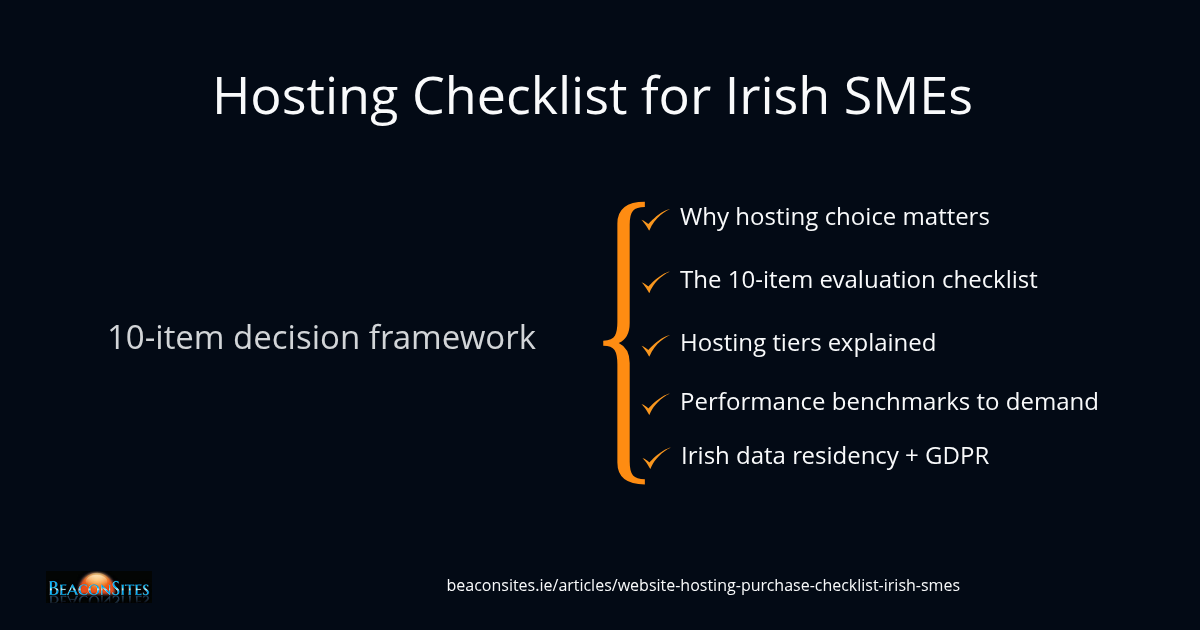
Most Irish SMEs choose a website host on price alone. The decision takes ten minutes — compare three quotes, pick the cheapest that mentions Ireland or Europe somewhere in the listing, set up the direct debit, move on. Six months later the same SME usually discovers that the choice silently constrained site performance, security posture, or reliability — and that switching providers is more painful than choosing correctly the first time.
Hosting choice does not feel high-stakes when you make it. It becomes high-stakes the first time something goes wrong: a slow page load that costs a conversion, an outage on the morning of a campaign launch, a customer noticing a security warning in their browser, a data subject access request that the provider cannot answer because the data is on a server outside the EU.
This article documents a 10-item purchase checklist Irish SMEs can use to evaluate hosting providers in 15 minutes. It covers the four hosting tier categories, the performance benchmarks any commercial provider should disclose, the security must-haves, and the Irish-specific considerations (EU data residency, GDPR compliance) that distinguish hosting suitable for Irish SMEs from generic global hosting that happens to be available in Ireland.
For the related question of what a maintenance plan should include after hosting is chosen, see What's Included in a Hands-Off Managed WordPress Plan.
Why hosting choice matters more than most Irish SMEs realise
Hosting choice does not feel high-stakes when you make it. It becomes high-stakes when something goes wrong, and by then switching is harder than choosing correctly the first time was. Four typical failure modes account for almost all hosting-related pain Irish SMEs experience.
Slow page loads. Underpowered shared hosting means the server takes one to three seconds longer to start responding than a properly-resourced equivalent. Across a year of traffic, that latency costs enquiries — the published research consistently shows conversion rates dropping meaningfully for each additional second of page load time.
Outages. Bargain hosting often skips proper redundancy. When the server fails (and all servers fail eventually), the brand's site is offline until manual intervention restores it. On a commercial site where the website is a lead source, even four hours of downtime during business hours can cost more than a year of premium hosting.
Security incidents. Cheap hosting frequently lacks the perimeter security and malware scanning that a commercial site needs. A compromised site can mean weeks of remediation, brand-trust damage, and in regulated industries, formal reporting obligations.
Compliance gaps. Hosting located outside the EU creates data-residency complications under GDPR, particularly for Irish SMEs handling customer data. Hosting that does not document where data is stored is a compliance risk waiting to be raised by a data subject or a regulator.
Each of these failure modes is preventable. The 10-item checklist below catches them at the purchase stage rather than at the discovery-of-the-problem stage.
Hosting choice does not feel high-stakes when you make it. It becomes high-stakes when something goes wrong, and by then switching is harder than choosing correctly the first time was.
The 10-item hosting purchase checklist
Run this checklist against any hosting quote before signing. If the provider cannot answer three or more items confidently in writing, look at a different provider.
- Hosting tier. Shared, VPS, managed WordPress, or enterprise. The tier should match the site's commercial weight, not the brand's appetite for the lowest monthly fee.
- Server location. Where the actual server is physically located. For Irish SMEs handling EU customer data, Ireland or another EU country is preferred for GDPR alignment.
- Uptime commitment. An explicit uptime SLA (typically 99.9 per cent or better for commercial-grade hosting). Providers without an uptime commitment are not measuring uptime.
- Page load performance. A documented target for time-to-first-byte and full page load, and a baseline measurement on a comparable existing site if available.
- Backup policy. Automated daily backups stored off-site, with a stated retention window and a documented restore process. Backups stored on the same server as the live site are not really backups.
- Security baseline. SSL certificate included, malware scanning enabled, a perimeter firewall, and brute-force login protection at the platform level. These are non-negotiable for any commercial site in 2026.
- Resource allocation. How much CPU, memory, and storage the site is allocated; whether resources are shared with neighbouring sites; and what happens during traffic spikes.
- Support response time. A defined first-response SLA for technical issues, with named contact channels and stated hours.
- Migration support. Whether the provider handles the migration from your current host (most professional providers do, at no cost); the timeline; and the downtime window during the switch.
- Pricing transparency. A clear monthly fee with no introductory teaser pricing, no aggressive renewal increases, and no surprise charges for routine support requests.
A reputable provider will answer all ten items confidently and in writing within 48 hours of being asked. A provider that hesitates, deflects, or insists on a sales call before answering is signalling that the answers are not where the brand wants them to be.
A great website on bad hosting is still a slow, unreliable website. An average website on great hosting is at least fast, secure, and available. Hosting is the foundation everything else sits on.
The four hosting tier categories: shared, VPS, managed WordPress, enterprise
Hosting falls into four tier categories. Each is appropriate for different brand stages and different commercial weights. Choosing the wrong tier — either too cheap or too expensive — is one of the most common Irish SME hosting mistakes.
Shared hosting (€3-15 per month). Many sites running on the same physical server, sharing CPU, memory, and storage. Suitable for personal sites, very low-traffic brochure sites, or first-month launches when traffic is essentially zero. Not suitable for any site where downtime or slow load times have a measurable business cost. The economics force the provider to over-pack the server, which produces unpredictable performance.
Virtual private server, or VPS (€20-80 per month). A partition of a physical server with dedicated resources. Suitable for sites with predictable moderate traffic, brands with technical staff who can configure and maintain the server, or sites with specific software requirements. The brand is responsible for the server operating system, security patching, and most platform-level concerns. The cost saving versus managed hosting only makes sense if technical capacity exists in-house.
Managed WordPress hosting (€30-100 per month). A platform purpose-built for WordPress sites, with automated maintenance, performance optimisation, security hardening, and support staff who know WordPress specifically. The right choice for most Irish SME commercial websites. The brand does not need technical staff; the provider handles the platform; the brand handles the content.
Enterprise hosting (€150+ per month). Dedicated infrastructure, custom configurations, white-glove support, high uptime SLAs (99.95 per cent or better). Justified for e-commerce sites with significant transaction volume, sites with bespoke functionality, or brands where the website is the primary commercial channel and even short outages are materially costly.
For most Irish SMEs running commercial websites, managed WordPress is the tier that maps cleanly to the actual requirement. The shared tier is too risky; the enterprise tier is over-spec for the volume.
Walk away from any hosting provider that treats basic performance figures as proprietary information. Vague performance language is the most reliable warning sign in hosting marketing copy.
Performance benchmarks any commercial provider should disclose
Five performance benchmarks any commercial provider should be willing to disclose and commit to in writing. Vague performance language is the most reliable warning sign in hosting marketing copy.
Uptime SLA. The percentage of time the server is committed to be available. 99.9 per cent is roughly 8.7 hours of downtime per year; 99.95 per cent is about 4.4 hours; 99.99 per cent is about 52 minutes. Commercial-grade hosting should commit to 99.9 per cent at minimum.
Time to first byte. The latency between a browser requesting a page and the server starting to respond. Under 300 milliseconds is good; 300 to 600 milliseconds is acceptable; above 600 milliseconds is a problem. Providers should disclose typical figures.
Full page load time. The time for a complete page to render in a browser. Under 2 seconds is good; 2 to 4 seconds is acceptable; above 4 seconds is poor and will cost conversions. Page load is affected by site design as well as hosting, but hosting sets the floor.
Concurrent visitor capacity. How many simultaneous visitors the hosting allocation can serve without slowdown. Important for sites with traffic spikes (post-publish, post-campaign, post-PR-mention). Providers should publish or quote a number.
Scalability path. What happens when the site outgrows the current allocation. Can the provider upgrade in place without migration? What is the typical cost step-up? Sites that grow are well-served by hosting that grows with them; sites that hit a ceiling and need a full migration suffer disproportionately.
Providers that decline to disclose these benchmarks are usually below the published industry norms and prefer not to surface that fact. Walk away from any hosting provider that treats basic performance figures as proprietary information.
For Irish SMEs handling EU customer data, keeping the data within the EU avoids the additional GDPR overhead that comes with transferring data to third countries. Verify the actual data centre location, not just the company's headquarters.
Security must-haves and what they actually mean
Five security must-haves for any commercial Irish SME hosting plan. Each is non-negotiable in 2026. Hosting that lacks any of them is below the floor a commercial site needs.
SSL certificate included. Encryption for traffic between the visitor's browser and the server. Modern browsers warn visitors when sites are not served over SSL, which produces an immediate trust collapse. SSL should be included at no extra cost in any 2026 hosting plan; providers that charge extra for it are signalling a pricing model from a decade ago.
Malware scanning. Regular automated scans of the site files looking for malicious code injected through plugin vulnerabilities, theme exploits, or compromised credentials. A weekly or daily scan with quarantine of detected malware is the standard for managed plans.
Perimeter firewall. A filter sitting in front of the site that blocks malicious traffic before it reaches the application. Stops a meaningful share of automated attack traffic that would otherwise reach the WordPress login page and similar exposed surfaces. Managed providers typically include this; unmanaged providers usually do not.
Brute-force protection. Limits on how many login attempts can be made against the site from a single source before the source is blocked. Without this, automated credential-stuffing attacks run continuously against every WordPress site on the public internet.
Backup verification. Not just that backups happen, but that the provider periodically verifies the backups can actually be restored. Untested backups have an alarmingly high failure rate; tested backups are dramatically more reliable.
The five together are not exotic and not expensive. Any provider unable to include all five at the managed-tier price point is mis-pricing their plan, mis-specifying their security baseline, or both.
The fifteen minutes it takes to run the checklist is the cheapest insurance against the six-month-later regret pattern that drives most provider switches.
Irish-specific considerations: EU data residency, GDPR, and local support
Three Irish-specific considerations distinguish hosting suitable for Irish SMEs from generic global hosting that happens to be available in Ireland.
EU data residency. Where the brand's customer data is physically stored. For Irish SMEs handling EU customer data (which is most of them, given that most customers are local), keeping the data within the EU avoids the additional GDPR overhead that comes with transferring data to third countries. Hosting located in Ireland, the Netherlands, Germany, or France is straightforward; hosting in the United States or other non-adequacy jurisdictions creates compliance work. Verify the actual data centre location, not just the company's headquarters.
GDPR-aligned terms. The hosting provider's data processing agreement should explicitly cover GDPR obligations: data processor responsibilities, breach notification timelines, sub-processor disclosure, data subject access request handling. Providers that operate primarily outside the EU often have weaker DPAs that put more obligation on the brand than is necessary.
Local support hours and language. Support staff who work in or near the European timezone, respond in plain English (not heavily templated AI replies), and understand the Irish business context. The cost of cheap global support becomes visible the first time an urgent issue requires translation through three layers of ticket systems before reaching someone who can actually fix it.
None of these three add significantly to the hosting cost for a properly-positioned managed WordPress provider. They are the difference between hosting that fits the Irish SME context naturally and hosting that requires extra workarounds to make the same context work.
For Irish SMEs that want all three baked in by default, choose a hosting plan from a provider with operational presence in Ireland or the EU, an explicit EU data residency commitment, a GDPR-aligned DPA available for review, and support in the European timezone. BeaconSites' Maintenance and Care plan is built on this baseline.
Data and evidence
| Data point | Value | Source |
|---|---|---|
| Number of items on the BeaconSites hosting purchase checklist | Ten | BeaconSites editorial framework, June 2026 |
| Recommended hosting tier for commercial Irish SME websites | Managed WordPress, €30 to €80 per month | BeaconSites market review across Irish web hosting providers, June 2026 |
| Minimum uptime SLA for commercial-grade hosting | 99.9 per cent (approximately 8.7 hours of downtime per year) | Industry-standard commercial hosting benchmark |
| Security must-haves for any commercial Irish SME hosting plan | Five (SSL included, malware scanning, perimeter firewall, brute-force protection, verified backups) | BeaconSites managed-WordPress security baseline, June 2026 |
Terms used in this article
- 10-Item Hosting Purchase Checklist
- The BeaconSites decision framework Irish SMEs use to evaluate hosting providers before signing. Ten items: hosting tier, server location, uptime commitment, page load performance, backup policy, security baseline, resource allocation, support response time, migration support, and pricing transparency. A reputable provider answers all ten confidently and in writing within 48 hours. Providers that fail three or more items are signalling that their offer does not survive scrutiny.
- EU Data Residency
- The principle that personal data of EU customers should be physically stored on servers within the European Union, or a country with a GDPR adequacy decision, to minimise compliance overhead. For Irish SMEs handling EU customer data, hosting located in Ireland, the Netherlands, Germany, France, or other EU countries is the path of least friction under GDPR. Hosting in non-adequacy jurisdictions (notably the United States in many configurations) requires additional safeguards like standard contractual clauses and transfer impact assessments. Verifying the actual server location, not the provider's headquarters, is the key check.
- Commercial-Grade Hosting Baseline
- The minimum hosting specification suitable for a commercial Irish SME website where downtime or slow load times have a measurable business cost. The baseline includes: managed WordPress hosting tier, EU data residency, 99.9 per cent uptime SLA at minimum, time to first byte under 600 milliseconds, daily off-site backups with verified restore, SSL certificate included, malware scanning, perimeter firewall, brute-force login protection, and support response times of 1 to 4 hours during business hours. Hosting that does not meet all of these is below the floor a commercial site needs and is a candidate for replacement at the annual review.
Common questions
What hosting tier should an Irish SME website be on?
For commercial Irish SME websites — sites where downtime or slow load times have a measurable business cost — managed WordPress hosting in the €30 to €80 per month range is the right tier. Shared hosting (under €20) is too unpredictable for commercial use; VPS (€20-80) requires in-house technical staff to manage; enterprise (€150+) is over-spec until the brand has significant transaction volume or bespoke requirements. The managed WordPress tier is the only one where the provider handles the platform completely and the brand handles only the content.
Why does EU data residency matter for an Irish SME?
Under GDPR, transferring personal data outside the EU to countries without an adequacy decision (notably including the United States in many configurations) requires additional safeguards: standard contractual clauses, transfer impact assessments, data protection addenda. None are impossible, but all add overhead the brand could avoid by simply choosing a hosting provider with an EU data centre. For Irish SMEs handling primarily Irish or EU customer data, EU residency is the path of least friction. Verify the actual server location during purchase — many global providers list Ireland or Europe as available regions but default new customers to other locations.
How do I check the performance of a hosting provider before signing?
Three approaches. First, ask the provider directly for typical time-to-first-byte and full page load figures for sites comparable to yours, and request a reference site on their platform you can test. Second, run free performance testing tools (Google PageSpeed Insights, GTmetrix, WebPageTest) against the reference site to verify the provider's claims.
Third, ask for a 14 or 30-day trial or money-back period, migrate a test site, and measure actual performance under your real conditions. Providers that decline all three of these requests are signalling that their performance does not survive independent measurement.
What is the difference between shared hosting and managed WordPress hosting?
Shared hosting puts many unrelated sites on the same physical server, sharing CPU, memory, and storage. The provider handles the bare minimum infrastructure and leaves WordPress-specific concerns to the brand. Managed WordPress hosting is a platform purpose-built for WordPress sites, with automated platform maintenance, WordPress-aware performance optimisation, security hardening tuned for WordPress vulnerabilities, and support staff who know WordPress specifically.
Managed costs more (€30-100 versus €3-15) but the per-site outcomes are dramatically different. For a commercial site, managed WordPress is almost always the right choice; shared is acceptable only for very low-stakes personal sites.
Should I include hosting in my web design quote, or buy it separately?
For Irish SMEs without in-house technical staff, bundling hosting with the web design and ongoing maintenance is significantly simpler. One provider, one invoice, one point of contact when something goes wrong. The risk of bundling is being locked into a hosting provider whose performance or pricing later degrades.
The mitigation is to choose a designer who uses an industry-standard managed WordPress platform (so migration to a different provider is straightforward later) rather than a designer who hosts on their own proprietary infrastructure. BeaconSites' web design and maintenance services use industry-standard managed WordPress hosting so the brand retains the option to migrate if circumstances change.
How often should I review my hosting plan?
Annual review at minimum. Hosting providers change their pricing, performance, and feature sets over time, and a plan that was competitive 18 months ago may now be overpriced or under-resourced. The annual review should include: comparing the current plan against alternatives, checking that performance benchmarks are still being met, confirming the security baseline is still complete (new requirements emerge), and verifying the data residency and GDPR posture have not changed (some providers shift infrastructure quietly). Switching providers is more painful than choosing well the first time, so the goal of the annual review is to catch creeping problems before they reach the point where switching is the only fix.
Hosting is the foundation everything else sits on. A great website on bad hosting is still a slow, unreliable website. An average website on great hosting is at least fast, secure, and available.
The 10-item checklist above is the minimum due diligence Irish SMEs should apply before signing a hosting agreement. The fifteen minutes it takes to run the checklist is the cheapest insurance against the six-month-later regret pattern that drives most provider switches.
For Irish SMEs whose website is a commercial asset, the hosting band that makes sense is managed WordPress in the €30 to €80 per month range, with EU data residency, an explicit uptime commitment, daily off-site backups, and a security baseline that includes SSL, malware scanning, and a perimeter firewall. Cheaper than that and you are probably on shared hosting with no real operational backing; more expensive than that and you are usually paying for enterprise features the business does not need yet.
BeaconSites' Maintenance and Care plan bundles managed WordPress hosting with the six-pillar maintenance framework documented in the companion article. The hosting tier is calibrated for Irish SMEs running commercial websites; the data resides in the EU; the uptime commitment, backup retention, and security baseline are all explicit in the plan documentation. Starts at €49 per month.
For brands still at the website-build stage and choosing hosting as part of a new build, the BeaconSites Website Design service includes hosting setup, configuration, and migration as standard — calibrated to the same EU-residency, performance, and security baselines this article documents.